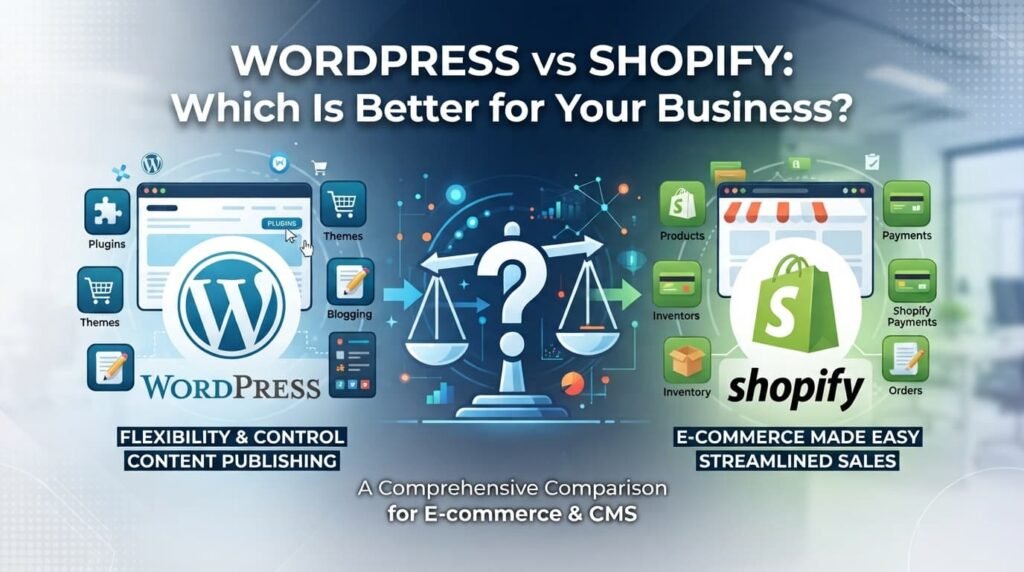
If you’re building a website in 2026, you’ve almost certainly landed on this question: WordPress vs Shopify which is better for your business? It’s one of the most searched comparisons in web development, and for good reason. Both platforms power millions of live websites, but they were built to solve different problems.
WordPress is a open-source content management system that can be turned into an online store with WooCommerce. Shopify is a all-in-one ecommerce platform that is made specifically for selling products online. Neither is universally “better”. The best option depends on your business model, how comfortable you’re with technology and your plans, for growth.
In this guide, we’ll break down the real differences between WordPress and Shopify: cost, ease of use, design flexibility, ecommerce features, SEO, and scalability so you can make a confident, informed decision.
What Is WordPress?
WordPress is a free, open-source content management system (CMS) that powers a large share of websites on the internet. It comes in two flavors that often confuse beginners:
- WordPress.org: is a self-hosted platform. You get the software for free. Set it up on your own hosting service. This means you have control over how your website looks what plugins you use and what features are available.
- WordPress.com: is a hosted version. It is a managed option that has restrictions. It is similar in approach, to the way Shopify operates with its hosted model.
WordPress on its own is a content platform that’s ideal, for blogs, portfolios and business websites. If you want to sell products many people install WooCommerce, a plugin that transforms WordPress into a fully functional online store.
Best suited for: heavy businesses, blogs, service-based businesses and hybrid sites that require both a store and strong content marketing.
What Is Shopify?
Shopify is a hosted, all-in-one ecommerce platform built specifically for selling online. There’s no separate hosting to manage, no core software to install you sign up, choose a plan, and start building your store immediately.
As of 2026, Shopify’s plan lineup includes:
| Plan | Monthly Price (annual billing) | Best For |
|---|---|---|
| Starter | $5/mo | Selling via social links, no full storefront |
| Basic | $29/mo | Solo founders, new stores |
| Grow (formerly “Shopify”) | $79/mo | Growing stores needing better reporting |
| Advanced | $299/mo | Scaling brands, lower transaction fees |
| Plus | From $2,300/mo | High-volume, enterprise businesses |
Shopify also introduced an Agentic plan ($0/mo) in 2026, designed for merchants who want to sell their catalog through AI shopping assistants without maintaining a traditional storefront.
Best suited for: product-first businesses, dropshipping, DTC brands, and non-technical founders who want to launch fast.
Quick Comparison Table
| Factor | WordPress (+ WooCommerce) | Shopify |
|---|---|---|
| Cost | Free software, but hosting + plugins + themes add up | Transparent monthly plans + transaction fees |
| Ease of use | Steeper learning curve | Beginner-friendly, guided setup |
| Design flexibility | Nearly unlimited (full code access) | Good, but customization often needs Liquid/dev help |
| Ecommerce features | Modular, plugin-dependent | Built-in checkout, inventory, shipping, cart recovery |
| SEO | Highly flexible, strong for content marketing | Solid basics, less granular control |
| Scalability | Depends on hosting quality | Scales automatically |
| Security | Self-managed | Fully managed by Shopify |
| Support | Community-driven, no official 24/7 line | 24/7 official support on all plans |
| Best for | Content-first businesses, blogs, custom builds | Product-first ecommerce businesses |
WordPress vs Shopify for Ecommerce (WooCommerce vs Shopify)
This is where the comparison gets most competitive, since so many businesses land here while shopping for an ecommerce platform.
WooCommerce (WordPress) for ecommerce:
- Free plugin, but you’ll pay for hosting, an SSL certificate, and likely premium extensions
- Requires more setup: choosing a payment gateway, configuring shipping rules, managing plugin compatibility
- Extremely flexible you can sell physical products, digital downloads, subscriptions, bookings, and more
- Popular for dropshipping too, though it typically requires more manual configuration than Shopify’s dropshipping app ecosystem
Shopify for ecommerce:
- Built specifically to sell checkout, inventory tracking, shipping labels, and abandoned cart recovery work out of the box
- Transaction fees apply if you don’t use Shopify Payments (ranging roughly from 2% down to 0.6% depending on your plan)
- The App Store makes dropshipping, print-on-demand, and subscription selling fast to set up
Bottom line: If ecommerce is your core business and you want to launch quickly with minimal technical overhead, Shopify usually wins. If you want maximum control over a hybrid content-and-commerce site, WooCommerce is the stronger long-term fit.
Ease of Use & Setup
Shopify was designed for people without technical backgrounds. You can go from signup to a live store in an afternoon, with guided onboarding and drag-and-drop theme editing.
WordPress has a steeper learning curve. You (or a developer) need to choose hosting, install WordPress, select a theme, and configure plugins including WooCommerce if you’re selling products. It’s more powerful, but it demands more time and, often, more troubleshooting.
Winner for beginners: Shopify. Winner for control: WordPress.
Design & Customization
WordPress offers close to unlimited design freedom. With thousands of free and premium themes, plus full access to HTML, CSS, and PHP, developers can build almost anything.
Shopify’s themes are polished and conversion-optimized out of the box, but deeper customization usually requires learning Liquid (Shopify’s templating language) or hiring a Shopify developer/app to extend functionality.
If your brand needs a highly custom look and feel, WordPress gives you more room to build exactly what you envision. If you want a professional store fast without touching code, Shopify’s themes will get you there quicker.
Pricing: WordPress vs Shopify Cost
A common misconception is that WordPress is “free” and Shopify is “expensive.” In reality, both have costs they’re just structured differently.
WordPress costs typically include:
- Hosting: $5–$50+/month depending on quality and traffic
- Domain name: ~$10–15/year
- Premium theme (optional): $0–100 one-time
- WooCommerce extensions (payment gateways, shipping, SEO tools): $0–300+/year
- Developer time, if you’re not building it yourself
Shopify costs typically include:
- Monthly plan: $29–$299 (core plans, billed annually)
- Transaction fees if not using Shopify Payments (roughly 2% down to 0.6% depending on plan)
- Apps for extended functionality: often $0–50+/month each
- Premium theme (optional): $0–350 one-time
For a small store, total costs on either platform often land in a similar $50–150/month range once hosting, apps, and extensions are factored in. WordPress can be cheaper if you’re technically capable and keep your plugin stack lean; Shopify’s pricing is more predictable since it’s bundled into one subscription.
Is WordPress or Shopify cheaper? It depends on your technical skill. WordPress has a lower price floor but a less predictable total cost. Shopify has a higher price floor but a more predictable, all-inclusive cost.
Is WordPress or Shopify Better for SEO?
Both platforms can rank well in search results SEO success depends more on content quality and technical execution than the platform itself. That said, there are real differences:
WordPress SEO advantages:
- Granular control over URL structures, meta data, and site architecture
- Powerful SEO plugins (like Yoast or Rank Math) for on-page optimization
- Better suited for content marketing at scale blogs, pillar pages, and internal linking are more flexible
Shopify SEO advantages:
- Clean, fast-loading themes by default
- Built-in SEO basics (meta tags, sitemaps, alt text) without needing a plugin
- Less flexibility over URL structure (e.g., product URLs often include
/products/by default)
Verdict: For businesses planning heavy content marketing and blogging as a growth channel, WordPress generally offers more SEO flexibility. For a straightforward product catalog site, Shopify’s built-in SEO tools are sufficient for most businesses.
Blogging: WordPress vs Shopify
WordPress was born as a blogging platform, and it shows. Its blogging tools categories, tags, scheduling, revision history, and a massive plugin ecosystem are more mature and flexible than Shopify’s built-in blog.
Shopify does include a blog feature, and it’s perfectly usable for product updates or basic content marketing. But if content is going to be a primary growth engine for your business, WordPress remains the stronger choice.
Scalability & Performance
Shopify is built on infrastructure that automatically handles traffic spikes useful during sales events or viral moments without you needing to manage servers.
WordPress scalability depends heavily on your hosting provider and how well your site is optimized (caching, image compression, plugin bloat). With quality managed WordPress hosting, it can scale just as well, but that requires more active management.
Security & Maintenance
Shopify handles security, PCI compliance, and platform updates for you there’s very little maintenance burden on the store owner.
WordPress requires you (or your host) to manage core updates, plugin updates, backups, and security hardening. This gives you more control, but also more responsibility. An unmaintained WordPress site is a common target for vulnerabilities.
Support & Community
Shopify offers official 24/7 support on every plan, including live chat and phone support on higher tiers.
WordPress doesn’t have one official support line you rely on documentation, community forums, plugin developers, or a managed hosting provider’s support team. The community is enormous, but support quality varies by where you get it.
WordPress vs Shopify for Small Business
For small businesses, the decision usually comes down to two questions: How technical are you (or your team)? and Is your business content-first or product-first?
- A local service business that mostly needs a professional website with occasional blog posts will likely do better with WordPress it’s cheaper to run long-term and better for local SEO content.
- A small business selling physical products online, especially with limited technical resources, will typically get to market faster and with less friction on Shopify.
How Do Other Platforms Compare? (Wix, BigCommerce, Magento, Webflow)
WordPress and Shopify aren’t the only options, and it’s worth a quick mention of where they sit relative to alternatives:
- Wix vs WordPress vs Shopify: Wix is more beginner-friendly than both but provides less flexibility and weaker ecommerce depth than Shopify and less content and SEO power than WordPress.
- WooCommerce vs Shopify vs BigCommerce: BigCommerce is similar to Shopify in structure (hosted, ecommerce-first). Has different pricing levels and built-in features that are worth looking at if transaction fees are a concern.
- Magento vs WordPress vs Shopify: Magento provides ecommerce customization like WooCommerce but with a much higher technical and cost burden that is usually best for large companies with dedicated development teams.
- Webflow vs WordPress vs Shopify: Webflow is great for design-focused marketing sites. Has a more limited ecommerce feature.
For most small-to-midsize businesses, the real decision still comes down to WordPress vs Shopify the alternatives serve more specific niches.
Who Should Choose WordPress?
WordPress is likely the better fit if you:
- Run a content-first business (blog, media site, service business)
- Want full design and code-level control
- Have development resources (in-house or freelance) or are comfortable learning
- Want to minimize recurring platform costs at scale
- Plan to combine content marketing with occasional product sales
Who Should Choose Shopify?
Shopify is likely the better fit if you:
- Are launching a product-first ecommerce business
- Want to go live quickly without hiring a developer
- Prefer predictable, all-in-one pricing
- Don’t want to manage hosting, security, or updates yourself
- Plan to scale order volume and need infrastructure that handles it automatically
Can You Use Both? (Hybrid Approach)
You don’t have to pick one option. Many companies use a WordPress site for writing articles and sharing content. Then add a Shopify store (using the “Buy Button” or a separate part of the website) to handle sales.
This mix of both lets you use the parts of WordPress for getting attention from search engines and creating content and also use the strong shopping features of Shopify for handling payments and sending out products.
FAQ
-
Is WordPress or Shopify better?
Neither is universally better WordPress offers more flexibility and content power, while Shopify offers faster setup and less maintenance for ecommerce specifically.
-
Is WordPress or Shopify better for ecommerce?
Shopify is generally better for pure ecommerce businesses because it includes checkout, inventory, and shipping tools out of the box. WordPress (via WooCommerce) is better if you need deep customization or a hybrid content-and-commerce site.
-
Is WordPress or Shopify better for SEO?
WordPress typically offers more SEO flexibility, especially for content marketing and blogging. Shopify’s built-in SEO tools are solid for a straightforward product catalog.
-
Is WordPress or Shopify cheaper?
WordPress has a lower cost floor but less predictable total costs. Shopify has a higher floor but bundles hosting, security, and support into one predictable monthly fee.
-
Can I switch from WordPress to Shopify later (or vice versa)?
Yes, migration is possible in both directions, though it typically requires careful handling of product data, URLs, and SEO redirects to avoid losing search rankings.
-
Do I need coding skills for either platform?
Not strictly for either both offer no-code website building. However, WordPress customization often benefits more from technical skills than Shopify’s guided setup does.
Conclusion
There’s no single winner in the WordPress or Shopify debate the right platform depends on your business model:
- Choose WordPress if you’re building a content-driven business, want maximum design and SEO flexibility, and have (or plan to hire) technical support.
- Choose Shopify if you’re building a product-first ecommerce business and want to launch quickly with minimal ongoing maintenance.
Whichever you choose, the platform is only part of the equation strong products, clear messaging, and consistent marketing will matter more to your long-term success than the software behind your site.