

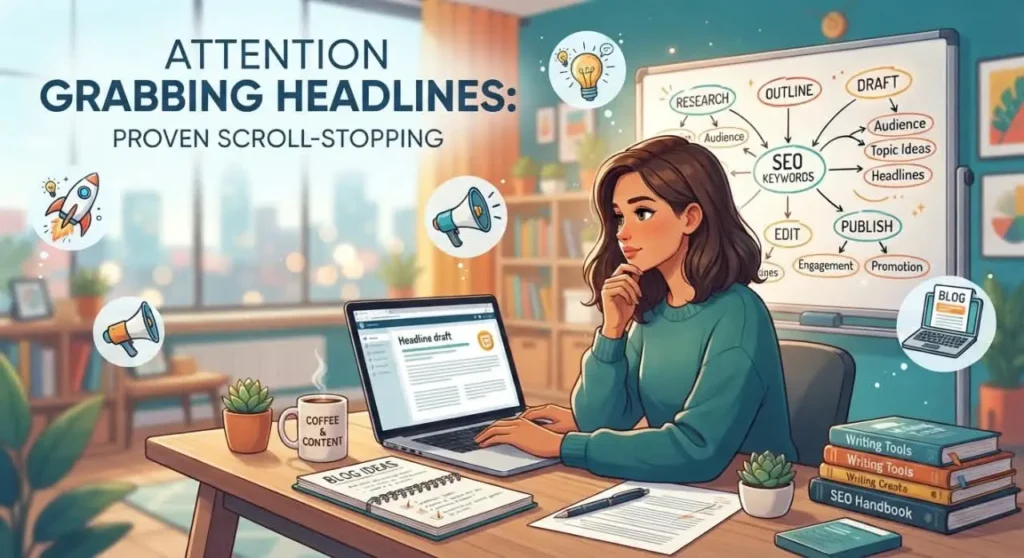
You have less time than you think. The average person scrolls past hundreds of pieces of content a day, and most of it disappears from memory before it even finishes loading. If your headline or opening line doesn’t earn a fraction of a second more attention, nothing else you wrote matters not your research, not your storytelling, not your call to action. That’s why learning to write attention grabbing headlines isn’t a nice-to-have skill for writers and creators. It’s the entire game.
This guide breaks down the mechanics behind hooks that actually work the psychology, the formula, and the exact techniques you can steal today, whether you’re writing a blog headline, a video intro, or a caption meant to stop someone mid-swipe.
How to Write a Hook That Stops Scrolling
There’s a simple, brutal rule behind every piece of content that performs: the first three seconds decide everything. On social platforms, algorithms are watching for early drop-off, and viewers are deciding almost unconsciously whether to keep watching, reading, or scrolling past. On a blog or search result, the equivalent window is your headline plus the first sentence.
Most content fails this test not because the idea is bad, but because the opening buries the idea. Writers tend to warm up a little context, a little throat-clearing before getting to the point. Readers and viewers don’t grant that warm-up period. They’ve already decided within the first line whether this is worth their time.
The fix is to front-load the tension. Open with the thing that creates a question in the reader’s mind, not the thing that answers it. A hook’s only job is to make someone need to know what comes next.
What Makes Attention Grabbing Headlines Work
Underneath every hook that performs, you’ll usually find one of three psychological triggers doing the work.
Curiosity Gap
This is the space between what someone knows and what they want to know. A headline like “The one habit that changed how I write” doesn’t tell you the habit it creates an itch you need to scratch. The gap has to be real, though. If the payoff doesn’t match the promise, you get a click, but you lose trust, and trust is what keeps people coming back.
Bold Claim or Contradiction
Headlines that challenge an assumption stop people because they interrupt the pattern of what the reader expected to see. “Everything you know about productivity is backwards” works because it creates friction with existing belief the reader has to stop and resolve that tension, either by agreeing or by wanting to argue back. Both reactions keep them reading.
Relatable Pain Point
Sometimes the hook isn’t clever at all it’s just specific. Naming a frustration someone is currently feeling (“Why your emails get ignored, even when they’re good”) works because recognition is its own kind of pull. People don’t need to be intrigued by something abstract when you’ve just described their exact problem back to them.
The strongest attention grabbing headlines usually combine at least two of these a bold claim wrapped around a pain point, for example, or a curiosity gap built on something relatable.
The Social Media Hook Formula, Step by Step
Headlines and video hooks follow a slightly different rhythm than long-form openings, but the underlying formula holds. Here’s the version built specifically for social content.
Step 1: Identify the Core Emotion or Tension
Before you write a single word, know what feeling you’re aiming at: frustration, curiosity, validation, fear of missing out, humor. A hook without a targeted emotion tends to read as generic, even if the words are technically fine. Pick the emotion first, then write toward it.
Step 2: Lead With the Payoff, Not the Setup
This is the single most common fix that improves a weak hook. Most people write their hook the way they’d tell a story out loud background first, punchline last. Flip it. State the outcome, the surprising result, or the stakes immediately, then backfill the context afterward for anyone still watching or reading.
Step 3: Use Specific, Concrete Language
“This changed my business” is forgettable. “This one email template got me three new clients in a week” is not. Specificity does two things at once: it makes the claim more believable, and it gives the brain something concrete to grab onto instead of a vague abstraction it can safely ignore.
Hooks for Short-Form Content vs. Written Headlines
A well-built hook adapts to its medium, even though the underlying principle earn the next few seconds stays constant.
What Changes for Video vs. Text
In written content, a reader can re-read a headline, glance at the subhead, and decide at their own pace. There’s a small buffer of patience built in. Video has none of that. Short-form content hooks have to work in real time, with no chance for the viewer to pause and reconsider if the first frame or the first line of spoken audio doesn’t land, they’re already gone.
This means video hooks generally need to be more visual and immediate, often pairing a strong verbal hook with an equally strong visual one, while written headlines can rely more heavily on wordplay, structure, and implication.
The First 3 Seconds of a Video Hook
For short-form video specifically, the first three seconds function like a second headline a make-or-break moment on top of whatever title or caption exists. The most effective openings tend to do one of three things immediately: ask a direct question the viewer wants answered, show a result before explaining how it was achieved, or interrupt an expectation (“Stop doing this if you want more engagement”). Avoid intros, avoid “hey guys,” and avoid any sentence that could be cut without losing meaning if it’s cut-table, cut it.
10 Viral Hook Examples You Can Steal
Templates work because they isolate the structure without requiring you to reinvent it from scratch. Adapt these to your own voice and topic.
- “Nobody talks about this, but ___”— positions you as revealing insider information.
- “I tried [thing] for [time period]. Here’s what happened.”— built-in curiosity plus a promised payoff.
- “The biggest mistake people make with [topic] is ___”— pain point plus authority.
- “You’ve been doing [common task] wrong this whole time.”— bold claim, mild provocation.
- “Here’s what I wish someone told me before ___”— relatable regret, implies useful hindsight.
- “This [number]-second trick will change how you [do X].”— specificity plus low commitment ask.
- “Stop [common behavior] immediately.”— direct, commanding, pattern interrupt.
- “What if everything you knew about [topic] was wrong?”— classic contradiction hook.
- “[Result] in [short timeframe] — here’s exactly how.”— concrete outcome plus promised process.
- “The real reason [common belief] isn’t true.”— curiosity gap wrapped in authority.
Hook Writing Techniques That Kill Engagement (Mistakes to Avoid)
Knowing what works matters less if you’re not also avoiding what quietly kills scroll-stopping content before it has a chance.
- Generic openers. Phrases like “In today’s world” or “Have you ever wondered” signal to the brain that nothing new is coming, and it tunes out before the actual point arrives.
- Slow starts. Any hook that spends its first sentence on throat-clearing has already lost the reader who needed convincing in the first place.
- No payoff. A hook that promises intrigue but delivers something flat trains your audience to stop trusting your openings which makes every future hook less effective, even the good ones.
- Overused click-bait Audiences have become pattern-literate. If a hook feels manipulative rather than genuinely intriguing, it reads as bait, and platforms increasingly penalize the resulting drop-off too.
- Burying the specific detail. Vague language is safe, but safety doesn’t stop scrollers specificity does.
How to Test and Improve Your Hooks
Even a well-built hook is a hypothesis until you’ve tested it against real behavior.
A/B test your openers. Run two versions of the same piece of content with different hooks and compare performance. Small changes leading with a question instead of a statement, for instance can produce out-sized differences in click-through or watch time.
Use retention graphs to diagnose drop-off. Most platforms show you exactly where viewers leave. If your retention graph shows a steep drop in the first few seconds, the hook is the problem, not the content that follows it. If retention holds early but falls later, the hook worked the issue is somewhere else in the piece.
Treat your hook like a live experiment, not a finished product. The formula gives you a strong starting point; your own data tells you what your specific audience actually responds to.
FAQ
-
What makes attention grabbing headlines effective?
They combine a psychological trigger usually a curiosity gap, a bold claim, or a relatable pain point with specific, concrete language that gives the reader something real to latch onto rather than a vague promise.
-
How do you write a hook that stops scrolling?
Front-load the tension instead of the context. Lead with the outcome, the surprise, or the stakes, and save background explanation for after you’ve earned the reader’s attention.
-
What’s the best social media hook formula?
Identify the core emotion you want to trigger, lead with the payoff rather than the setup, and use specific, concrete details instead of generic claims.
-
How long should the first 3 seconds of a video hook be?
Exactly that three seconds or less before you’ve delivered your strongest line, image, or claim. Anything longer, including greetings or intros, risks losing the viewer before your actual content begins.
Conclusion
The best writers don’t have better ideas than everyone else they just refuse to bury them. Every technique in this guide exists to do one thing: get your best idea in front of the reader before they have a reason to leave. You don’t need a perfect hook on your first try you need to start treating your openings with the same care you give the rest of your content. Here’s what to carry with you:
- The first three seconds (video) or the headline plus first sentence (text) determine whether the rest of your content gets seen at all.
- Effective hooks rely on curiosity gaps, bold claims, or relatable pain points often combining two of the three.
- Lead with the payoff, not the setup, and use concrete, specific language over vague claims.
- Video and written hooks share the same principles but need different execution video has no buffer for patience.
- Test your hooks the same way you’d test any other assumption: with real data, not guesses.
Start with your next headline apply one technique from this list and watch what changes.