Let’s be honest. Most of us have posted something we were proud of, watched the likes trickle in, and then noticed that nobody bought a thing. If that sounds familiar, the problem usually isn’t your effort. It’s that the content wasn’t built to move anyone toward a decision.
The good news is that you don’t need a huge budget or a viral reel to fix it. The social media content ideas that actually convert tend to be simple, and they follow the same path your own buying decisions do. You notice a brand. You check whether other people trust it. You work out if it understands your problem. You decide whether you like the people behind it. Then, maybe weeks later, you buy.
This article walks through four types of content that match that path: social proof, educational posts, behind-the-scenes content, and direct calls to action. Along the way, you’ll also get two practical guides, one on how to turn customer questions into social media posts and one on how to use FAQs to generate social media leads. There’s a weekly posting plan at the end, plus answers to a few common questions.
The Four Social Media Content Types at a Glance
| Content type | Main job | Post ideas | Good call to action |
|---|---|---|---|
| Social proof | Builds credibility | Testimonials, before-and-after posts, case studies | “See the full story” |
| Educational | Builds trust | How-tos, myth-busting, quick tips, FAQ answers | “Save this for later” |
| Behind the scenes | Builds connection | Process videos, team intros, origin story | “Meet the team” |
| Direct call to action | Drives sales and sign-ups | Offers, lead magnets, product spotlights | “Book your free call” |
Why so much content gets likes but no sales
I see the same three patterns again and again.
The first is brands that only talk about themselves. “We’re thrilled to announce…” works for exactly nobody outside the company. People scroll to be entertained or to learn something, not to read an ad.
The second is the opposite: a brand posts lovely, useful content for a year and never once says “here’s how to work with us.” Followers enjoy it, then move on with their day.
The third is posting with no purpose. If you can’t say what a post is meant to do, it probably won’t do anything.
So before you create anything, decide the job of the post. The four types below cover the most important jobs.
Social Proof Content
Anyone can say they’re great. What actually persuades a stranger is seeing that someone like them got a real result. Every potential customer is quietly asking, “Has this worked for people like me?” Social proof answers that before they have to ask, and it takes the risk out of saying yes.
Ways to use it
Start with testimonials, but skip the generic ones. Screenshot a kind message from a customer (ask permission first), put it on a simple background, and post it as a story or carousel. A real name and a real message beat polished marketing copy every time. If a customer sends you a voice note or a short video, even better.
Before-and-after posts are the fastest way to show value. A tidy kitchen, a redesigned logo, a website that now loads in two seconds instead of eight. If your work creates a visible change, show it.
Case study carousels work well because almost nobody reads a long case study, but plenty of people will swipe through five slides. Keep the structure simple:
- Who the customer is and what was going wrong
- What they had already tried
- What you did
- The result, with a number if you have one
- A short invitation to get in touch
You can also reshare photos and videos that customers post about you. This is user-generated content, and it’s powerful because the person has no reason to exaggerate. A small card in your packaging asking people to tag you is often all it takes to get started.
Smaller things count too. “200 orders shipped this month,” a press mention, an award, or a partnership with a brand people recognise all tell newcomers that you’re the real thing.
Getting better proof
The difference between a weak testimonial and a strong one is usually the question you asked. “Did you enjoy working with us?” gets you “Yes, great!” Try “What changed for you after we worked together?” instead. You’ll get answers like “I saved five hours a week,” which is far more convincing.
Mix up the types of results you share, too. Not every win has to be dramatic. “It arrived early and fit perfectly” is relatable, and you’ll have plenty of those. And please don’t fake anything. Invented reviews damage trust the moment they’re spotted, and in many places they break advertising rules.
Educational Content
If proof earns credibility, teaching earns trust. When you give away useful knowledge, people start to see you as the expert for the problem, long before they’re ready to spend money.
It also changes the dynamic. Instead of asking for attention, you’re paying for it with value.
What to teach
Simple how-to posts are the classic. A photographer could show how to pose naturally in photos. A bakery could explain how to keep sourdough fresh for a week. Pick something your audience struggles with and walk them through it.
Myth-busting also works well, because almost every industry is full of bad advice. “3 skincare myths that waste your money” gives you a reason to be helpful and a little bit opinionated at the same time. Mistake posts do something similar, since people love finding out what not to do before they do it.
Quick tips are great for social media because they’re easy to take in and easy to share. Checklists and cheat sheets get saved and revisited, which tells the platform your content is worth showing to more people. And if something changes in your industry, be the first to explain what it means in plain language.
A few habits make educational posts land better. Lead with the problem, not the topic: “Struggling to get customers to leave reviews?” will stop more thumbs than “A guide to review collection.” Stick to one idea per post. Make your first line count, because that’s all most people will read before deciding to stay or scroll. And don’t be afraid of giving away your best ideas. Explaining the “what” and “why” makes people realise how much work the “how” is, and that’s when they call you.
How to turn customer questions into social media posts
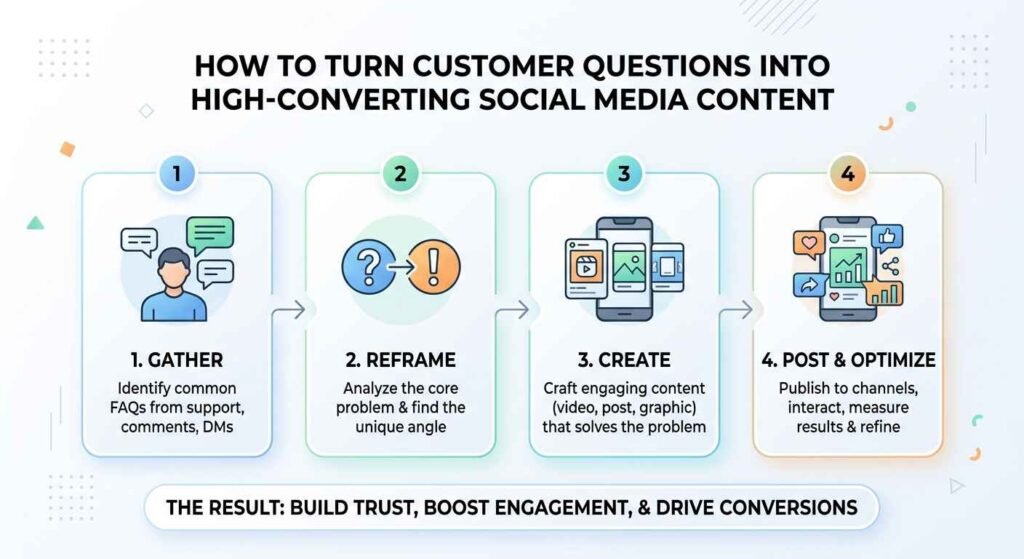
This is the easiest source of content ideas you’ll ever find, and you already have it. Every question in your DMs, comments, emails, reviews, and sales calls is a ready-made post, written in the exact words your audience uses. Here’s how to turn customer questions into social media posts without overthinking it.
- Keep a running list. Whenever someone asks you something, drop it into a notes app or spreadsheet. Check your DMs, comments, and emails once a week for new ones.
- Sort them into themes. You’ll notice they cluster around a handful of topics: price, how it works, results, timing, and how you compare to alternatives.
- Pick a format that fits. A quick answer can be a text post or story. A process can be a reel or carousel. A big topic can become a short series.
- Open with the question itself. “Can beginners use this?” is a better hook than anything you’d invent, because it’s what someone is already wondering.
- End with a next step. Ask people to save it, send you their own question, or book a call.
Here’s an example. A bakery that keeps hearing “Can I order a custom cake last minute?” can film a short reel covering turnaround times and link to the order form. One repeated question becomes a useful post, and the people who needed that answer are already close to buying. That’s why these posts tend to get saves, shares, and enquiries. You’re not guessing what people want to know. You’re answering what they already asked.
Behind-the-Scenes Content
People don’t only buy products. They buy from people and brands they feel something about. Behind-the-scenes content makes your business feel human, and in a feed full of polished ads, that stands out.
What to show
A day in the life is the simplest place to start. Show the morning coffee, the packing table, the client call that ran long. It doesn’t need to be impressive. It needs to be real.
Process videos are surprisingly addictive to watch. A candle maker pouring wax, a developer building a feature, a baker shaping dough. They also build respect for the care behind what you sell.
Your origin story matters more than you’d think. Why did you start? What problem did you run into yourself? People root for founders they understand, so be honest about the messy parts. The same goes for mistakes. A post about the time you ruined your first batch, and what you learned from it, makes you more relatable than a dozen perfect photos.
Introduce your team with a short bio and a fun fact. Show your workspace and the tools you swear by. Share a sneak peek of something you’re working on, because followers who feel involved in the journey are far more likely to show up on launch day.
If you care about sustainability, community, or quality, show it rather than saying it. Show where you source materials, or what you do with your leftovers.
Keeping it genuine
Don’t over-polish. A slightly shaky phone video with real personality often beats a studio production with none. If you’re comfortable on camera, show your face, because faces build familiarity. If not, show your hands, your workspace or your team. And tell stories instead of facts. “We make handmade soap” is fine, but the moment you realised your first batch smelled like cabbage is better.
Use Stories for the everyday stuff and save your feed for your best material.
Direct Call-to-Action Content
This is the type many brands avoid, and it’s often the one that closes the loop. You’ve built credibility, given value, and made people feel connected. Now you have to invite them to do something. If you never ask, most won’t.
A lot of business owners worry about sounding pushy. But once you’ve earned attention with the other three types, a clear offer isn’t pushy. It’s useful. You’re simply telling people how to get the result they already want.
Ideas that work
Spotlight a product or service, but talk about the benefit before the feature. “Our planner has 120 pages” is a fact. “Plan your week in ten minutes and stop feeling overwhelmed” is a reason to buy.
Limited-time offers create healthy urgency, as long as the deadline is real. False scarcity gets noticed and costs you trust. Free consultations, trials, and samples lower the barrier to saying yes. New launches and restocks deserve a clear announcement with a link.
Lead magnets are one of the best tools here. Offer a free guide, checklist, or template in exchange for an email address, and you’ve turned a follower into a contact you can reach without depending on an algorithm.
And sometimes the simplest post is the best one: “We have three client spots open this month. DM us to book yours.”
A few rules help. Use one action per post, whether that’s “click the link in bio,” “send us a DM,” or “book your free call.” Several asks confuse people. Make it easy, because every extra step costs you, someone. Mention a guarantee or what to expect so people feel safe acting. And repeat your offers. Not everyone sees every post, so it’s fine to promote the same thing in different ways over a few days.
How to use FAQs to generate social media leads
FAQs aren’t only for your website. On social media, they remove hesitation and attract people who are already interested. If you want to know how to use FAQs to generate social media leads, this is the process I’d follow.
- Start with pre-purchase questions. Pick the ones people ask right before they buy: price, timing, “will this work for me?” These bring in the warmest leads.
- Answer one question per post. Keep it focused and end with a single call to action that captures the lead, like “Book a free call,” “Download the checklist,” or “DM us the word GUIDE.”
- Make it a series. A weekly “FAQ Friday” gives your audience something to look forward to and builds a library of answers over time.
- Use question stickers. Stories let people send questions directly. Each reply is new content and also a conversation you can follow up on.
- Keep your best answers visible. Pin top FAQ posts to your profile or save them in Highlights so new visitors see them first.
- Reply fast. When someone asks a question in the comments or DMs, answer quickly and point them to the next step. Quick, helpful replies are how curiosity turns into leads.
For extra impact, pair your FAQ posts with a lead magnet. Offer a free guide that answers your ten most common questions, and ask people to comment or click your bio link to get it.
A simple weekly plan
You don’t need to post every type every day. Balance matters more than volume. Here’s a rhythm you can start with:
- Monday: an educational tip
- Tuesday: A behind-the-scenes short video or quick educational insight
- Wednesday: a testimonial or customer result
- Thursday: a how-to, checklist, or answer to a common question
- Friday: a behind-the-scenes post
- Weekend: a direct offer, or something lighter like a poll
If that feels like too much, drop to three posts a week: one that teaches, one that shows proof or personality, and one offer. Consistency beats quantity.
A good rule of thumb is to keep about 80% of your posts helpful, relatable, or trust-building, and about 20% promotional. If your feed is all offers, people tune out. If it never has one, nobody buys.
Two habits will save you time. First, batch your content. Set aside one block each week to film several videos, write captions, and schedule everything. Second, repurpose. One customer success story can become a testimonial graphic, a carousel, a short video, and a story. Same idea, many formats.
How to tell what’s working
You don’t need complicated analytics. Watch a handful of signals.
Saves and shares tell you the content was valuable enough to keep or pass on, and they often matter more than likes. Comments and DMs show real interest, and the questions in them are a goldmine for future posts. Link clicks show who’s moving from the post to your page. Sign-ups, inquiries, and sales are the real results, so even a simple “How did you hear about us?” is worth asking.
Once a month, look at your top three and bottom three posts and ask what the best ones had in common. Was it the topic, the format, the first line, the call to action? Then do more of that.
Mistakes to avoid
- Chasing every trend. Views are nice, but if the content doesn’t connect to what you sell, it won’t convert.
- Ignoring comments and DMs. Social media is a conversation. Reply and answer questions.
- Disappearing for weeks. Pick a posting frequency you can actually keep up.
- Writing lazy captions. Visuals get attention, but captions persuade. Spend time on your first line and your closing call to action.
- Neglecting your profile. Your bio and link are your storefront. Say who you help, what you offer, and what to do next.
- Quitting too early. Results rarely show up overnight. Give each approach enough time and enough posts to learn from.
FAQ
-
What are the best social media content ideas to increase conversions?
The most effective ideas fall into four groups: social proof (testimonials, before-and-after posts, case studies), educational content (tutorials, tips, myth-busting), behind-the-scenes content (process videos, team stories), and direct call-to-action content (offers, lead magnets, FAQs). Together they build credibility, trust, and connection, and then invite people to act.
-
How often should I post on social media to get conversions?
Consistency matters more than frequency. For most small businesses, three to five quality posts a week is realistic and effective. Choose a schedule you can keep up for months, because steady posting builds familiarity and trust over time.
-
What is the 80/20 rule in social media marketing?
It means roughly 80% of your posts should educate, entertain, or build trust, while about 20% directly promote your products or services. This keeps your audience engaged without making them feel constantly sold to.
-
How do I get customer testimonials for social media?
Ask a few days after purchase, while the experience is fresh. Use specific questions like “What was your biggest result?” or “What nearly stopped you from buying?” Always get permission before sharing, and save screenshots of unsolicited praise so you can ask to post them.
-
How long does it take to see results from social media content?
Most businesses need two to three months of consistent posting before real patterns show up. Early signs include more saves, shares, comments, and direct messages, which usually appear before sales go up.
Conclusion
Great social media content ideas don’t have to be complicated. Show proof that you deliver. Teach something useful. Let people see the humans behind the brand. And ask clearly for the next step. Each one does a different job, and together they move someone from “never heard of you” to “I’m ready to buy.”
If you only do one thing this week, start with your customers’ questions. Turn two or three of them into posts, add one clear call to action to each, and see what happens. Then pick one idea from each of the four types, spread them across your week, and keep an eye on what people respond to.
Start small, stay consistent, and always give people a clear next step.