

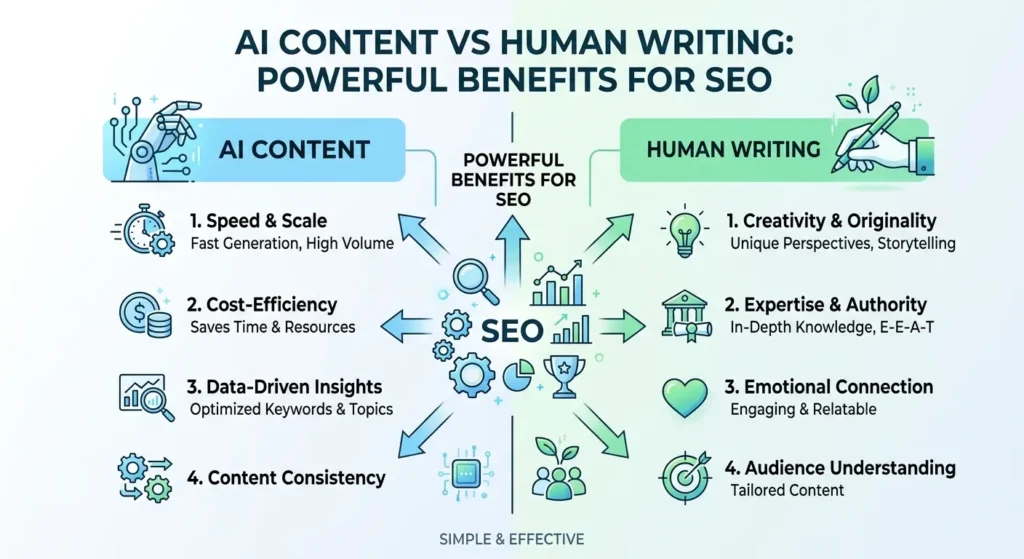
Have you ever wondered whether AI-generated content or human-written content performs better in search engines? As AI writing tools grow in popularity, businesses and content creators are changing how they produce website content.
Today, tools like ChatGPT can generate blog posts, suggest keywords, create content outlines, and improve readability within minutes. However, human writers still play an important role by bringing creativity, personal experience, critical thinking, and original insights into content creation.
So, when it comes to SEO, which approach works best?
The answer is not simply AI or human writing. Both approaches have different strengths, and combining them can help businesses create more valuable content.
In this guide, we’ll explore AI Content vs Human Writing, explain seven powerful benefits of using both approaches, and share practical ways to create SEO-friendly content that meets readers’ needs.
What Is AI-Generated Content?
AI-generated content is written with the assistance of artificial intelligence tools. These tools use language models to generate text based on user instructions, prompts, and available information.
For example, ChatGPT can help content creators:
- Generate blog post ideas.
- Create article outlines.
- Suggest relevant keywords.
- Write initial content drafts.
- Improve grammar and readability.
- Organize H2 and H3 headings.
- Generate frequently asked questions.
AI tools make content creation faster and help writers organize their ideas. However, AI-generated content still requires human review to ensure accuracy, originality, and usefulness.
What Is Human-Written Content?
Human-written content is created by people using their knowledge, research, creativity, and personal experience.
Human writers can understand audience needs, explain complicated topics, share real-world examples, and provide unique perspectives.
For example, an SEO writer who has worked on website optimization projects can explain practical challenges, describe solutions, and share lessons learned from real projects.
Human writing can provide:
- First-hand experience.
- Original opinions and insights.
- Creative storytelling.
- Emotional understanding.
- Contextual knowledge.
- Critical thinking.
- Personalized communication.
These qualities help make content more meaningful and useful for readers.
AI Content vs Human Writing: Key Differences
Although both approaches aim to provide useful information, they differ in their writing processes, capabilities, and strengths.
| Feature | AI Content | Human Writing |
|---|---|---|
| Writing speed | Very fast | Usually slower |
| Creativity | Generates ideas from learned patterns | Uses independent creative thinking |
| Personal experience | Cannot independently provide personal experiences | Can share real experiences |
| Research assistance | Helps organize and summarize information | Can conduct research and evaluate sources |
| Accuracy | Requires fact-checking | Also requires fact-checking |
| SEO optimization | Helps with keywords and content structure | Applies SEO strategy and audience understanding |
| Scalability | Can generate drafts at scale | Requires more time and effort |
| Emotional understanding | Can imitate emotional language | Understands human context and emotions |
Neither approach is automatically better. The quality of the final content depends on research, expertise, accuracy, originality, and how effectively it answers users’ questions.
7 Powerful Benefits of Combining AI Content and Human Writing for SEO
Using AI tools alongside human expertise can improve the content creation process. Here are seven important benefits of combining both approaches.
1. Faster Content Creation
One of the biggest advantages of AI writing tools is their ability to speed up content production.
Writing a complete article requires topic research, keyword analysis, outlining, drafting, and editing. AI tools can assist with several of these tasks.
For example, you can use ChatGPT to generate an outline for an article about technical SEO. Instead of starting with a blank page, you can review the suggested structure and improve it according to your audience’s needs.
Human writers can then refine the draft, add relevant examples, and remove unnecessary information.
SEO benefit: A more efficient writing process gives businesses additional time for research, editing, optimization, and content updates.
2. Better Keyword Research and Content Planning
Keyword research is an important part of SEO content creation. It helps you understand what people search for and which topics are relevant to your audience.
AI tools can help identify related topics, suggest keyword variations, and organize content ideas into relevant groups.
For example, if your primary topic is SEO content writing, AI can suggest related topics such as:
- SEO-friendly content.
- Content optimization.
- Search intent.
- Keyword placement.
- Content strategy.
- Helpful content.
However, AI-generated keyword suggestions should not replace actual keyword research.
You can use tools such as Google Search Console, Google Trends, and Semrush to evaluate keyword opportunities, search demand, and competition.
SEO benefit: Combining AI suggestions with keyword research helps create more relevant content plans and better topic coverage.
3. Improved Content Structure and Readability
Well-organized content makes it easier for readers to find information.
AI tools can help organize articles into logical sections, suggest headings, and simplify complicated explanations.
For example, when writing an article about on-page SEO, you can ask AI to organize the topic into sections such as title tags, meta descriptions, internal linking, heading structure, and image optimization.
A human editor can then review the structure and ensure every section answers a relevant question.
You should also focus on:
- Using descriptive H2 and H3 headings.
- Writing short paragraphs.
- Explaining technical terms clearly.
- Using bullet points where appropriate.
- Maintaining a natural writing style.
SEO benefit: Clear organization improves readability and helps search engines understand the structure and topics covered by your content.
4. More Original and Valuable Content
AI tools can generate useful explanations, but their initial drafts may contain common information that appears across many websites.
This is where human experience becomes important.
Human writers can improve AI-assisted drafts by adding original examples, practical explanations, research findings, and relevant observations.
For example, instead of simply explaining what Google Search Console does, an SEO writer can describe how they use its Performance report to identify pages with impressions but low click-through rates.
This makes the explanation more practical and informative.
SEO benefit: Original insights and useful examples help differentiate your content and provide additional value to readers.
5. Better Content Accuracy and Trust
Accuracy is essential when creating SEO content.
AI tools can sometimes generate incorrect information, outdated recommendations, or unsupported statistics. Publishing such information without reviewing it can reduce readers’ trust.
Human editors can improve content reliability by:
- Checking important facts.
- Verifying statistics and research.
- Reviewing information against reliable sources.
- Removing unsupported claims.
- Updating outdated recommendations.
- Checking examples for accuracy.
For example, if an AI tool provides a statistic about organic traffic, verify it using a reliable source before including it in your article.
SEO benefit: Accurate and trustworthy information creates a better experience for readers and supports content quality.
6. Consistent Content Production
Businesses need a consistent content strategy to cover important topics and maintain useful website resources.
AI tools can help create content calendars, generate topic ideas, and prepare initial drafts.
Human writers can review those drafts to maintain brand voice, writing quality, and consistency.
For example, a digital marketing agency can use AI to brainstorm blog topics related to SEO, social media marketing, and lead generation. Its content team can then select relevant ideas and develop them into informative articles.
However, consistency should never mean publishing content simply to increase article quantity.
Every article should have a clear purpose and provide useful information.
SEO benefit: A structured content production process helps businesses maintain their publishing plans while protecting content quality.
7. Easier Content Optimization and Updating
SEO does not end when an article is published. Website content needs regular reviews to maintain accuracy, relevance, and usefulness.
AI tools can help identify areas that may need improvement, suggest clearer headings, simplify explanations, and generate updated content drafts.
Human editors should review these suggestions before making changes.
For example, when updating an older SEO article, you can:
- Review its existing search performance in Google Search Console.
- Identify outdated information.
- Check whether the article satisfies current search intent.
- Use AI to suggest improvements.
- Add relevant examples and updated information.
- Review internal links and on-page SEO elements.
- Publish the improved version.
SEO benefit: Regular content improvements help keep website resources useful, relevant, and aligned with audience needs.
How Search Engines Evaluate AI and Human-Written Content
Search engines aim to provide users with relevant, helpful, and reliable information.
Google does not automatically consider content low-quality simply because AI tools were used to create it.
To understand how search engines evaluate content quality, explore our guide on How Google Ranks Content in 2026.
Similarly, human-written content does not automatically receive better rankings.
The important factors include:
- Content quality.
- Originality and usefulness.
- Accuracy and reliability.
- Relevance to search intent.
- First-hand experience where appropriate.
- Overall page experience.
Content created primarily to manipulate search rankings rather than help users can create problems, regardless of whether AI or humans produced it.
Therefore, businesses should focus on creating content that genuinely answers readers’ questions instead of concentrating only on the writing method.
How to Create SEO-Friendly Content Using AI and Human Writing
Combining AI assistance with human expertise requires a clear process. Follow these steps to create useful and search-friendly content.
Step 1: Understand Your Audience
Before writing, identify your target audience and understand what information they need.
For example, someone searching for “AI content vs human writing” probably wants to understand which writing method is more effective for SEO.
Your article should directly address this question.
Step 2: Perform Keyword Research
Find your primary and secondary keywords using SEO research tools.
Consider:
- Search intent.
- Search volume.
- Keyword difficulty.
- Related search terms.
- Competitor content.
Use keywords naturally rather than repeating them unnecessarily.
Step 3: Create a Content Outline
Prepare a clear article structure before writing.
You can use AI to brainstorm headings and organize important subtopics. Review the suggested outline to ensure it covers the topic properly without unnecessary sections.
Step 4: Generate an Initial Draft
Use AI tools to prepare an initial draft, explain difficult concepts, and organize information.
Treat the generated content as a starting point rather than a finished article.
Step 5: Add Human Expertise
Review the draft and include relevant experience, practical examples, original insights, and useful explanations.
Remove generic statements and information that does not contribute to the topic.
Step 6: Optimize the Content for SEO
Review important on-page SEO elements, including:
- SEO title.
- Meta description.
- URL slug.
- H1, H2, and H3 headings.
- Primary and secondary keywords.
- Internal links.
- Relevant external references.
- Image alt text.
Make sure the article satisfies search intent and is easy to read.
Step 7: Edit, Fact-Check, and Publish
Before publishing, check grammar, readability, factual accuracy, and content originality.
Review the complete article to ensure it provides meaningful information and does not contain unnecessary repetition.
After publishing, monitor its performance through Google Search Console and update it when necessary.
Common Mistakes to Avoid When Using AI for SEO
Although AI tools can make content creation easier, beginners sometimes make mistakes that affect content quality.
Here are some common mistakes to avoid:
- Publishing AI-generated articles without editing.
- Depending entirely on AI for research.
- Repeating keywords unnaturally.
- Creating generic content without original insights.
- Including unsupported facts and statistics.
- Ignoring search intent.
- Copying competitor content without adding value.
- Publishing large amounts of low-quality content.
- Forgetting to update outdated information.
Remember, AI should support your content strategy rather than replace research, experience, and critical thinking.
Which Is Better for SEO: AI Content or Human Writing?
The answer depends on how each approach is used.
AI content is useful when you need help with brainstorming, organizing information, preparing drafts, and improving writing efficiency.
Human writing is valuable when a topic requires personal experience, original insights, creative thinking, and a deeper understanding of the audience.
For most businesses, combining both approaches is a practical content strategy.
Use AI to improve your workflow, but let human expertise guide the final content.
The Future of AI Content and Human Writing in SEO
Content creation is continuously evolving as artificial intelligence becomes more accessible.
Businesses are increasingly using AI tools to support research, content planning, writing, and optimization.
However, producing content has become easier, which makes originality, expertise, and usefulness increasingly important.
Websites that publish repetitive information without providing additional value may struggle to differentiate themselves.
In the future, successful content strategies will need to focus on:
- Original research and insights.
- Helpful and accurate information.
- Real-world examples.
- Strong topical knowledge.
- Clear communication.
- Better user experiences.
Writers who understand both AI tools and traditional SEO practices can build more effective content strategies.
FAQ
-
Is AI-generated content good for SEO?
Yes. AI-generated content can perform well in SEO when it is helpful, accurate, original, and relevant to users. Search engines focus on content quality rather than simply the method used to create it.
-
Does Google penalize AI-generated content?
Google does not automatically penalize content simply because AI was used to create it. However, content generated primarily to manipulate search rankings without providing value may violate Google’s spam policies.
-
Is human-written content better than AI content?
Not necessarily. Human-written content can offer personal experience, creativity, and original insights, while AI content provides speed and efficiency. Both can be effective when they meet users’ needs.
-
Can I use ChatGPT to write SEO blog posts?
Yes. You can use ChatGPT to generate ideas, create outlines, prepare initial drafts, and improve readability. However, review the content, verify important facts, and add original insights before publishing.
-
How much AI-generated content is acceptable for SEO?
There is no fixed AI-generated content percentage or word limit for SEO. The important factors are accuracy, usefulness, originality, and whether the content meets users’ needs.
-
Which is better for SEO in 2026: AI content or human writing?
Both can be effective. Combining AI assistance with human expertise is a practical approach because it balances content production efficiency with originality, accuracy, and quality.
-
Can AI content rank on Google?
Yes. AI-assisted and AI-generated content can appear in Google search results when it meets Google’s quality requirements and provides useful information to readers.
Conclusion
AI Content vs Human Writing is not about choosing one over the other. Both approaches offer valuable benefits for creating high-quality SEO content. AI writing tools help speed up content creation, improve content planning, organize information, and support keyword research. Human writers bring creativity, personal experience, critical thinking, and original insights that make content more meaningful and useful.
By combining AI assistance with human expertise, businesses can create accurate, engaging, and SEO-friendly content that satisfies search intent and provides real value to readers. The key is to use AI as a supporting tool rather than relying on it completely.
Ultimately, successful SEO content depends on quality, originality, relevance, and user satisfaction, not simply whether it is written by AI or a human.