

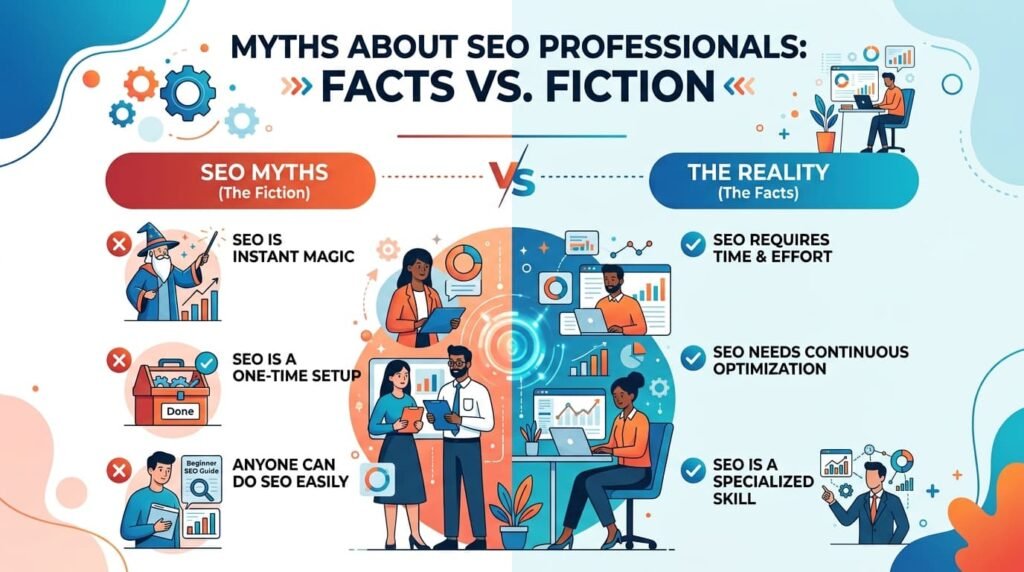
Have you ever told someone that you work in SEO and heard them ask, “So you just add keywords to websites?” If so you are not alone.
Search engine optimization is often misunderstood. Some people think SEO experts can bring any website to the top of Google in a days. Others think the job is about adding keywords building backlinks or changing website settings.
These misunderstandings create business expectations. They also ignore the research, technical knowledge, content strategy and analysis that’re part of SEO.
In this article we will explore ten myths about SEO professionals. We will explain the facts, behind each myth. Show what businesses should realistically expect when hiring an SEO expert.
Myth 1: SEO Professionals Can Guarantee the #1 Position on Google
One of the biggest myths about SEO professionals is that they can guarantee the number-one position on Google.
Some businesses expect an SEO expert to promise a specific ranking before starting a project. Unfortunately, no SEO professional has complete control over Google’s search results.
Google uses many systems to evaluate and rank content. Search results can change because of competition, search intent, algorithm updates, and improvements made by other websites.
The truth
A skilled SEO professional can improve a website’s chances of ranking by identifying opportunities and addressing issues that may limit its visibility.
Their work may include:
- Researching relevant keywords and search intent.
- Improving website structure and internal linking.
- Creating useful, well-organized content.
- Identifying technical SEO issues.
- Earning relevant, trustworthy backlinks.
- Monitoring performance and adjusting the strategy.
However, these activities do not guarantee a specific position.
What businesses should remember: Choose an SEO professional who explains their strategy, sets realistic goals, and measures progress instead of promising guaranteed rankings.
Myth 2: SEO Professionals Can Deliver Results Overnight
Imagine hiring an SEO expert today and expecting your website to reach the first page of Google tomorrow. It sounds attractive, but SEO rarely works that way.
Some changes may produce relatively quick improvements, while others require months of work and evaluation. The timeline depends on factors such as the website’s existing condition, competition, content quality, and the type of improvements required.
The truth
SEO is a long-term process rather than an instant traffic solution.
An SEO professional may need to fix crawling issues, improve existing pages, publish new content, strengthen internal links, and monitor how search engines respond to these changes.
Even after implementing improvements, results may take time to become visible.
Paid advertising and SEO also work differently. Paid campaigns can generate traffic while ads are running, whereas organic search visibility depends on earning visibility in unpaid search results.
What businesses should remember: Ask for a realistic timeline, clear milestones, and regular performance reports. Look at progress over time rather than expecting immediate ranking changes.
Myth 3: SEO Experts Only Add Keywords to Websites
Many people think SEO consists of repeating a target keyword throughout a webpage. This misunderstanding comes from older approaches that focused heavily on keyword repetition.
For example, a business might believe that adding the phrase “best digital marketing agency” dozens of times will automatically improve its rankings.
In reality, excessive and unnatural keyword repetition can make content difficult to read and may violate Google’s spam policies when used to manipulate rankings.
The truth
Keyword research is important, but it is only one part of SEO.
A professional needs to understand why people search for a particular phrase and what information they expect to find. They then use that understanding to improve the content and the overall website experience.
Effective SEO work can include:
- Identifying search intent.
- Choosing relevant primary and secondary keywords.
- Improving titles and meta descriptions.
- Organizing content with clear headings.
- Adding useful internal links.
- Making pages easier to navigate and understand.
Keywords help professionals understand demand, but they should never replace helpful information.
What businesses should remember: Good SEO content answers the reader’s question naturally instead of repeating the same phrase unnecessarily.
Myth 4: SEO Professionals Only Make Technical Changes
Another common misconception is that SEO specialists spend their entire day editing website settings, changing meta tags, and fixing technical errors.
Technical SEO is important, but it does not represent the entire profession.
A technically sound website may still struggle to attract organic traffic if its content does not meet user needs or if it targets the wrong search intent.
The truth
SEO professionals combine technical knowledge with research, planning, and marketing strategy.
Depending on the project, their responsibilities may include:
- Analyzing competitors and market opportunities.
- Developing a keyword and content strategy.
- Reviewing website architecture.
- Improving landing pages.
- Identifying opportunities to attract qualified visitors.
- Measuring organic traffic, leads, and conversions.
They may also collaborate with developers, designers, writers, and business owners.
For example, an SEO specialist might discover that a service page receives impressions but few clicks. They could investigate the title, search intent, competing results, and page content before recommending changes.
What businesses should remember: SEO is not just about fixing website errors. It is about improving organic search visibility in ways that support business objectives.
Myth 5: SEO Is a One-Time Task
Some business owners believe they can optimize their website once and expect it to perform well indefinitely.
They may hire an SEO professional to update their website, complete a few technical fixes, and then assume no further work is necessary.
This approach overlooks how search behavior, competition, and websites change over time.
The truth
SEO requires ongoing monitoring and maintenance, although the amount of work depends on the website and its goals.
Competitors may publish better content, products and services may change, and technical problems can appear after website updates. Search engines may also change how they present results.
An SEO professional regularly reviews performance to identify opportunities and potential problems.
Ongoing work may include:
- Updating outdated information.
- Reviewing keyword performance.
- Fixing newly discovered technical issues.
- Improving pages that receive impressions but few clicks.
- Monitoring relevant competitors.
- Identifying content gaps.
Not every page needs constant editing. Changes should be based on evidence and a clear purpose.
What businesses should remember: SEO is an ongoing investment, but maintenance should focus on meaningful improvements rather than unnecessary changes.
Myth 6: SEO Professionals Are Becoming Useless Because of AI
Artificial intelligence has changed how people discover information online. AI-generated answers, conversational search tools, and new search features have created uncertainty about the future of traditional SEO.
Because of these changes, some people believe businesses no longer need SEO professionals.
The truth
AI is changing how people discover information, but businesses still need useful, accessible websites and effective ways to reach their audiences.
SEO professionals must adapt to these developments by understanding how search engines present information and how people find brands across different platforms.
Their work may include:
- Creating content that directly answers user questions.
- Improving the clarity and organization of website information.
- Maintaining technically accessible pages.
- Building brand credibility through useful resources and genuine expertise.
- Monitoring organic search performance and relevant AI-driven search experiences.
AI tools can assist with research, outlining, and analysis, but generated content still requires fact-checking, editorial judgment, and an understanding of the audience.
There is also no guaranteed formula for appearing in AI-generated answers.
What businesses should remember: Rather than abandoning SEO, focus on useful content, technical accessibility, credibility, and adapting your strategy as search behavior evolves.
Myth 7: Anyone Can Become an SEO Expert After Watching a Few Videos
Free tutorials, blogs, and online courses have made SEO knowledge more accessible than ever. Beginners can learn about keywords, backlinks, indexing, and on-page optimization without spending a fortune.
However, learning the terminology is different from developing the ability to solve real SEO problems.
The truth
SEO expertise develops through structured learning, practical experience, testing, and analysis.
For example, a beginner may know how to identify keywords with a research tool. An experienced professional must also evaluate whether those keywords match the business, whether the website can compete for them, and whether ranking for them could generate useful traffic.
Professional SEO work often requires knowledge of:
- Keyword research and search intent.
- On-page and technical SEO.
- Content planning and optimization.
- Link analysis and digital authority.
- Google Search Console and analytics.
- Competitor research and performance reporting.
Even experienced professionals need to continue learning because websites, tools, and search experiences evolve.
What businesses should remember: Certificates and courses can demonstrate learning, but practical problem-solving, transparent reporting, and relevant experience are also important when evaluating an SEO specialist.
Myth 8: SEO Professionals Use Secret Tricks to Manipulate Google
Some businesses believe SEO experts use secret tricks to force Google to rank websites. This can lead to unrealistic expectations and risky shortcuts, such as buying manipulative links or hiding text to influence rankings.
The truth
Professional SEO is based on research, strategic improvements, and understanding search engine guidelines. Ethical SEO experts test strategies and analyze results without relying on manipulative tactics that could harm a website.
What businesses should remember: Avoid SEO professionals who promise secret ranking tricks. Choose someone who explains their methods, sets realistic expectations, and measures results transparently.
Myth 9: SEO and Content Writing Are Completely Separate
Writers sometimes believe SEO limits creativity by forcing them to write for search engines instead of people. On the other hand, some SEO professionals focus heavily on metrics and overlook the quality of the actual content.
This creates an unnecessary divide between writing and optimization.
The truth
SEO and content writing work best when they support each other.
Keyword research helps writers understand the questions, concerns, and language of their audience. Content writing turns those insights into clear explanations, helpful examples, and engaging information.
An SEO professional may identify a topic that people search for, while a writer develops an article that answers the question in a useful and understandable way.
Together, they can improve:
- Topic relevance and search intent alignment.
- Content structure and readability.
- Accuracy and usefulness.
- Internal linking and navigation.
- Opportunities to attract relevant organic visitors.
However, including keywords alone cannot make weak content valuable. Likewise, excellent writing may need better discoverability and organization to reach its intended audience.
What businesses should remember: The goal is not to choose between SEO and creativity. It is to combine search insights with useful, original, reader-focused content.
Myth 10: SEO Professionals Make Organic Traffic Completely Free
Some businesses believe organic traffic costs nothing because Google does not charge for every click. However, improving search visibility requires time, expertise, and resources.
The truth
SEO professionals invest effort in keyword research, content optimization, technical improvements, and performance analysis. Businesses may also pay for SEO services, tools, and website updates.
Although organic clicks do not have a direct advertising cost, generating and maintaining organic traffic still requires investment.
What businesses should remember: SEO is not free, but a well-planned strategy can help attract relevant visitors and support long-term business growth.
What Does an SEO Specialist Actually Do?
An SEO specialist helps businesses improve their organic search visibility by identifying opportunities, solving website problems, and developing effective strategies. Depending on the project, their work may include keyword research, technical SEO, content optimization, competitor analysis, and performance reporting.
A reliable professional uses these activities to attract relevant visitors and support business goals while communicating realistic expectations.
How to Choose the Right SEO Professional
If you are planning to hire an SEO expert, understanding these myths can help you make a better decision.
Consider the following points before choosing a specialist or agency.
- Ask about their process. A professional should explain how they research, prioritize, implement, and evaluate SEO improvements.
- Set measurable goals. Agree on relevant objectives, such as improving qualified organic traffic, increasing conversions, or resolving technical issues.
- Request transparent reporting. Reports should explain what work was completed, what changed, and what the available data shows.
- Discuss realistic expectations. Rankings and timelines depend on many factors. Be cautious of guaranteed positions and promises of instant results.
- Evaluate relevant experience. Ask about similar projects, the challenges involved, and what can be demonstrated through reliable evidence.
- Encourage collaboration. SEO often works best when business owners, developers, designers, and content creators share information and work toward the same goals.
The right SEO professional will not necessarily promise the fastest results. They should be able to explain the work, justify their priorities, and communicate honestly about progress and limitations.
FAQ
-
Can an SEO expert guarantee first-page rankings?
No. An SEO expert can improve a website’s chances of ranking through keyword research, technical improvements, and content optimization. However, no professional can guarantee a specific Google ranking because search results depend on many factors beyond their control.
-
How long does SEO take to work?
SEO results depend on the website’s condition, competition, strategy, and implementation. Some improvements may become visible within a few months, while others take longer. A reliable SEO professional sets realistic expectations and tracks progress over time.
-
How can you identify a reliable SEO professional?
Look for someone who explains their strategy clearly, sets realistic expectations, provides transparent reports, and supports recommendations with evidence. Be cautious of guaranteed rankings and promises of instant results.
-
Does keyword stuffing still work?
No. Keyword stuffing involves repeating keywords unnaturally to manipulate search rankings. It can make content difficult to read and may violate Google’s spam policies. SEO professionals should use relevant keywords naturally while prioritizing helpful, user-focused content.
-
Are SEO professionals still necessary in 2026 with AI?
Yes. AI is changing how people search information. Companies still need websites that are easy to reach, helpful and reliable. Search engine optimization experts help companies adjust their content make their website work better and keep track of changes in how visible they’re, on search engines. AI tools can help with that work. Do not take the place of human thinking and smart choices.
Conclusion
The biggest myths about SEO professionals usually come from people wanting simple answers to something that’s actually quite complex.
SEO is not about putting keywords in the right places making technical tweaks or following some hidden tricks. It’s about work. Doing research creating good content making sure a website is easy to use planning smart moves and checking results over time.
A trustworthy SEO professional knows that each website is different. They look into what’s going wrong find chances to improve, talk honestly about what’s possible and make choices based on data.
For businesses knowing this helps in picking the expert setting goals that make sense and seeing if SEO is truly helping the business grow over time.
Want to boost your website’s organic visibility? Start by finding the SEO problems and chances that really matter to your business. Then build a plan, around goals you can measure. Not promises about rankings.