If you learned SEO by stuffing your target keyword into every sentence, I have some bad news: that playbook died years ago, and 2026 is burying it for good. Google’s algorithm no longer asks “does this page say the keyword enough times?” Google’s algorithm now asks “does this page actually answer what the person meant?”
That shift changes everything about how content should be written, structured, and optimized. This guide breaks down how Google ranks content in 2026, why relevance has replaced density as the real currency of SEO, and what you should actually be doing differently.
How Google Ranks Content in 2026
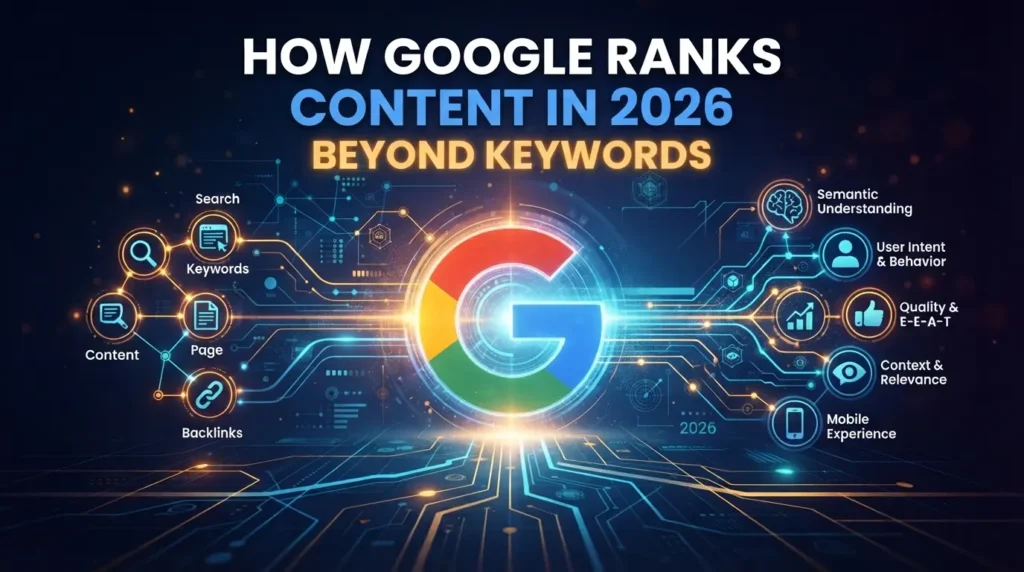
Modern ranking isn’t a single formula it’s a layered system. Google’s algorithms parse a page’s language for meaning (not just matching words), evaluate who wrote it and how credible they are, judge whether the content adds anything beyond what already exists on page one, and weigh user signals like whether people actually stick around and read.
Three things anchor this system right now:
- Semantic understanding:Google’s language models interpret intent and context, not just literal keyword matches. A search for ” running shoes for bad knees” and a search, for “running shoes that don’t hurt your joints” are treated as the same query.
- Quality and trust signals (E-E-A-T):Experience, Expertise, Authoritativeness, and Trustworthiness are not a direct ranking score. They heavily influence how Google’s systems and human quality raters judge whether a page deserves to rank since higher authority and trustworthiness tend to correlate with higher rankings.
- Information gain:Does the page say something new, or is it a reshuffled summary of the top 10 results that already exist? Google’s March 2026 core update doubled down on information gain, E-E-A-T, and topical authority as core ranking signals.
- The practical upshot: keyword usage now functions more like a label that helps Google categorize the page while relevance, depth and trust are what actually move the page up the results.
Ranking Factors in 2026 at a Glance
Google has never published a definitive weighted formula, but based on its own documentation and observed patterns, these are the factors that consistently matter right now:
- Semantic relevance:does the content match the meaning and intent behind the query, not just the words?
- E-E-A-T: experience, expertise, authoritativeness, and trustworthiness of the content and its author.
- Information gain:does the page add something beyond what’s already ranking?
- Core Web Vitals & page experience:loading speed, responsiveness, and visual stability (covered in detail below).
- Backlinks & authority signals:still a meaningful trust signal, though less decisive on their own than in the past.
- Structured data & entity clarity:helping Google (and AI systems) understand exactly what your content is about.
- User engagement signals:whether people actually read, stay, and don’t immediately bounce back to the results.
None of these work in isolation. A technically fast page with thin content won’t outrank a slower page that actually answers the question but a great answer buried under a slow, broken experience won’t reach its full potential either.
Content Relevance vs. Keyword Density What’s the Real Difference?
These two terms get confused constantly, so let’s separate them cleanly.
Keyword density: is a mechanical count how often a term (or its exact variants) appears relative to total word count. It’s a leftover metric from an era when search engines matched text strings, not meaning.
Content relevance: is about whether the page actually satisfies the query comprehensively, accurately, and in a way that matches what the searcher is trying to accomplish. Relevance is judged through:
- Topic coverage:does the page address related subtopics a thorough answer would need?
- Semantic proximity:does the vocabulary naturally surround the core concept, not just repeat one phrase?
- Query intent match:is this a “how-to,” a comparison, a definition, a buying guide and does the content match that format?
A page can have zero keyword-density issues and still rank poorly because it’s shallow. A page can barely repeat its target phrase and rank #1 because it’s the most complete, well-organized answer available. Density is a symptom of old optimization; relevance is the actual target.
A Brief History of Keyword-Based SEO
The keyword density era
In the early 2000s and into the 2010s, search engines relied heavily on literal text matching. If you wanted to rank for “cheap flights to Paris,” you repeated that exact phrase as many times as you could get away with in the title, headers, body text, alt tags, even hidden white text on white backgrounds. Tools promised “ideal density percentages” (often 2–3%), and entire content strategies were built around hitting them.
Why it broke down (and where BERT comes in)
This approach broke for a simple reason: it optimized for machines, not humans, and it produced genuinely bad content repetitive, keyword-crammed, hard to read. Google’s response was a series of algorithm updates aimed at understanding language the way people actually use it. The most pivotal of these was BERT (Bidirectional Encoder Representations from Transformers), introduced in 2019, which let Google interpret the full context of a sentence including prepositions and phrasing that used to get ignored rather than parsing queries word by word.
BERT didn’t kill keywords outright, but it ended the density game. Once Google could understand meaning and context, stuffing a phrase repeatedly stopped being an advantage and started being a liability, since keyword-stuffed content reads as low-quality to both algorithms and human quality raters.
Keyword Optimization vs. Search Intent: Finding the Balance
Keywords aren’t dead you still need them to signal topic and get discovered in search. But keyword optimization today means something different: using the right terms in the right places (titles, headers, opening paragraphs) to clearly establish what a page is about, while writing the actual content to satisfy intent, not to hit a repetition target.
Search intent generally falls into four buckets:
- Informational:“how does X work,” “what is Y”
- Navigational:looking for a specific brand or site
- Commercial investigation:“best X for Y,” comparison searches
- Transactional:ready to buy or sign up
The balance point: identify the keyword that describes your topic, then write to fully satisfy the intent behind it even if that means using synonyms, related concepts, and adjacent subtopics far more often than the exact phrase itself. If someone searches “keyword optimization vs search intent,” they want a framework for balancing the two, not ten repetitions of that exact string. Give them the framework.
What Google Actually Prioritizes Now
Search intent and semantic SEO
Semantic SEO extends the intent-matching idea into how content is structured: covering a topic in interconnected clusters rather than isolated pages, using natural language and related entities, and answering the follow-up questions a searcher would logically have next.
Topical authority
Google increasingly rewards sites that demonstrate depth across an entire subject area, not just a single well-optimized page. A site with a thorough, interlinked cluster of content around a topic signals more credibility than a single standalone article competing on the same keyword.
E-E-A-T
Experience, Expertise, Authoritativeness, and Trustworthiness continue to expand in weight. Google’s quality systems increasingly favor sites that people can visibly trust clear author bios and credentials, accurate and current information, transparent sourcing, and a real trust layer (secure site, clear contact details, honest policies). Recent Google updates have specifically rewarded first-hand experience and original insight over generic, templated rewrites of existing top-ranking content.
Core Web Vitals and Page Experience in 2026
Core Web Vitals are the technical layer sitting underneath everything else in this article. They won’t make thin content rank, but ignoring them can hold back content that’s otherwise strong. Google measures three metrics, scored on real visitor data (not lab tests) at the 75th percentile:
- LCP (Largest Contentful Paint):how fast the main content loads. Target: under 2.5 seconds.
- INP (Interaction to Next Paint):how quickly the page responds to a click, tap, or keypress. Target: under 200 milliseconds. INP replaced First Input Delay (FID) as the responsiveness metric in March 2024 and remains the current standard.
- CLS (Cumulative Layout Shift):how much the layout jumps around while loading. Target: under 0.1.
Current estimates put Core Web Vitals at roughly 10–15% of overall ranking weight real, but secondary to relevance, depth, and trust. In practice, they function more like a tie-breaker: when two pages are equally relevant, the one with the better real-world experience tends to edge ahead. The most useful starting point is Google Search Console’s Core Web Vitals report (field data), not a one-off Lighthouse score, since ranking is based on how real visitors experience your page, not a synthetic test.
How AI Overviews Are Reshaping SEO in 2026
AI Overviews are arguably the biggest disruption to how ranking translates into traffic right now. A large and growing share of Google searches end without a click at all, and that number climbs sharply on queries where an AI Overview appears particularly on mobile and for informational, non-branded searches like the ones this article targets.
The flip side matters just as much: brands and pages cited inside an AI Overview tend to see meaningfully higher click-through than competitors who rank organically but aren’t cited. Visibility inside the AI-generated answer is increasingly as valuable as sometimes more valuable than a top-three organic position.
What this means for how you write:
- Answer clearly and early:AI Overviews tend to pull concise, well-structured answers, so lead each section with a direct answer before expanding on it.
- Structure for extraction:Clear headers, short paragraphs, and FAQ or Q&A formatting make content easier for Google’s systems to lift and cite.
- Use FAQ schema markup:Structured data helps signal exactly which passages answer which questions.
- Keep E-E-A-T signals strong:AI Overviews lean on trusted, well-sourced content, so the credibility work described above directly affects citation odds, not just traditional rankings.
How to Optimize Content for Google’s Current Algorithm
- Start with intent, not the keyword:Before writing, search the term yourself. What format dominates page one listicles, guides, comparisons? Match it.
- Build topical depth:Cover the subtopics a thorough source would need to include, and interlink related content on your site rather than publishing isolated pages.
- Write for information gain:Add something the top-ranking pages don’t already cover original data, a clearer framework, a genuinely new angle.
- Signal E-E-A-T explicitly:Include author credentials, cite credible sources, keep information current, and make trust signals (contact info, policies, HTTPS) visible.
- Use keywords naturally, in the right spots:Title, H1, and opening paragraph should clearly signal topic but let the rest of the content flow around meaning, not repetition.
- Match content format to the SERP:If Google is already showing FAQs, comparison tables, or step-by-step guides for your term, structure your content that way.
- Fix the technical basics:Make sure Core Web Vitals are passing and content is structured (clear headers, FAQ schema) so both search rankings and AI Overviews can find and cite it.
Common Mistakes to Avoid
- Chasing a “perfect” keyword density: There isn’t one. Optimizing for a percentage instead of a reader produces worse content and worse rankings.
- Publishing thin, single-angle pages:A page that only skims the surface of a topic struggles against competitors with real depth.
- Ignoring author credibility:No bio, no credentials, no clear “who wrote this” signal this is an easy trust gap to close and a common reason otherwise decent content underperforms.
- Copying the top-ranking page’s structure:Matching format is smart; matching content with no new insight fails the information-gain test.
- Treating semantic SEO as unattainable: You don’t need to “beat” Google’s language model you need to write like a knowledgeable human answering a real question, which is exactly what these systems are built to reward.
FAQ
-
Does keyword density still matter for SEO in 2026?
Not in the way it used to. There’s no ideal percentage to hit. What matters is whether your content naturally and thoroughly covers the topic a searcher is asking about.
-
What replaced keyword density as a ranking factor?
Semantic relevance and intent matching evaluating whether content actually satisfies what a searcher meant, not just whether it repeats specific words.
-
Is keyword research still necessary?
Yes. Keywords still tell you what people are searching for and how to structure your content around it you just optimize for the intent behind the term, not the term’s repetition count.
-
How does E-E-A-T affect rankings if it’s not a direct ranking factor?
It shapes how Google’s quality systems and algorithms judge trustworthiness and credibility, which in turn influences how content performs even without a single measurable “E-E-A-T score.”
-
What is search intent in SEO?
It’s the underlying reason behind a search informational, navigational, commercial, or transactional and matching your content’s format and depth to that intent is central to ranking well today.
-
Do Core Web Vitals still affect rankings in 2026?
Yes, but as a secondary factor. They function more like a tie-breaker between pages that are already relevant and trustworthy, rather than a way to outrank thinner content on their own.
-
How are AI Overviews changing SEO?
They’re shifting value away from raw click-through and toward being cited as the answer itself. Clear, well-structured, well-sourced content is more likely to be pulled into an AI Overview and citation there tends to drive stronger clicks than a lower organic ranking without it.
Conclusion
Google’s ranking system in 2026 isn’t a puzzle to game it’s a reflection of what actually helps someone who typed a question into a search bar. Keyword density was never really the point; it was just the closest thing early search engines had to a proxy for relevance. Now that Google can understand meaning, intent, and trust directly, that proxy is gone, and so is the advantage of gaming it.
What replaces it is more work, but it’s work that compounds: write with real depth, build topical authority instead of isolated pages, make your expertise and credibility visible, keep the technical experience solid, and structure content so it’s easy to extract whether that’s for a human skimming your page or an AI Overview pulling an answer from it. None of these signals operate alone. A fast page with thin content won’t win, and neither will a brilliant answer buried in a slow, disorganized one.
The sites that will keep ranking and keep getting cited in 2026 are the ones that stopped optimizing for the algorithm and started optimizing for the person on the other end of the search. Get that right, and the rankings tend to follow.

2 Responses