

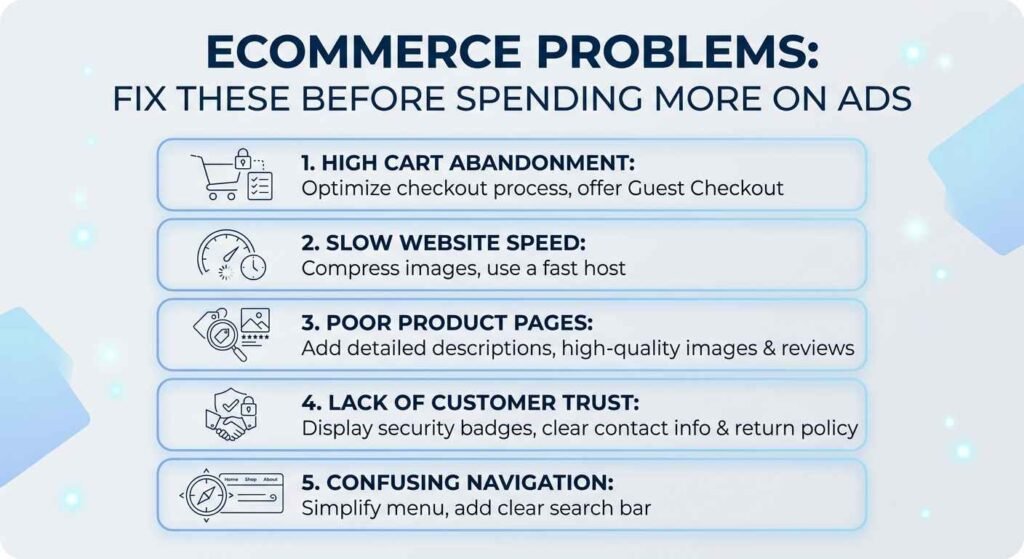
Sales are flat, so you bump the ad budget. It’s the most natural move in the world, and it’s often the wrong one.
Ads don’t fix anything. They send people to your store, and that’s all. If the store is slow, confusing, or hard to trust, you’re now paying more to disappoint more people. I’d rather see you spend a week fixing the basics than another month feeding money into a funnel that leaks.
So here’s the plan: what tends to break in online stores, why ecommerce ads are not converting when they do, and what to do about it before you scale.
Why Ecommerce Problems Can Make Your Ads Less Effective
Your ads and your store aren’t two separate things. They’re one machine, and the weakest part sets the pace.
Run the numbers on a simple case. You pay £2 per click and 1 in 100 visitors buys. That’s £200 in ad cost for every sale. If you get conversion up to 2%, the same clicks now cost £100 per sale. You didn’t touch a single ad. You just stopped wasting half the traffic.
There’s a knock-on effect too. Slow pages push people away fast, and weak engagement can hurt how ad platforms rate you. Sloppy targeting brings in people who buy the wrong thing and send it back. One problem quietly creates another, and by the time you notice, it’s hard to tell which ad or which page is to blame. Clean up the store first, and your data becomes a lot easier to read.
What Are the Most Common Problems of Ecommerce?
Three problems do the most damage to online stores right now: rising customer acquisition costs, high cart abandonment, and increasingly complex supply chain logistics. Each one shrinks your margins or wastes ad spend, which is why they keep showing up below. But they’re part of a longer list, and the ten problems that follow are the ones most worth fixing before you increase your budget.
1. Low Website Conversion Rates
Plenty of stores convert at 1% or below, and the cause is rarely mysterious. Someone clicks an ad promising one thing and lands on a page that says something slightly different, or nothing clear at all. Add a cluttered layout and a slow load, and they’re gone.
Open your own ad, click it, and look at the landing page as a stranger would. Can you tell what’s being sold, why it’s worth buying, and where to click within about five seconds? On a phone? If you hesitate, so does everyone else. That five-second test is the simplest way to improve ecommerce conversion rate without touching your ads.
2. Poor Customer Experience
Nobody writes a review about a smooth checkout. They write about the pop-up that covered the product, the forced account sign-up, or the email that took four days to get answered. Ecommerce customer experience problems are quiet. Customers don’t complain; they just leave.
The fastest test is also the most uncomfortable: buy something from your own store on your phone, on mobile data, without shortcuts. Write down every moment you feel annoyed. That list is your to-do list.
3. Weak Product Discovery and Site Search
People who use your search bar know what they want. That makes them some of your best visitors, and plenty of stores waste them. Search for “waterproof jacket,” get “no results,” and the shopper is off to a competitor.
Look at your search data. The queries returning nothing tell you exactly what customers expect you to sell, or what words they use for things you already sell. Add synonyms, fix typo handling, and make sure your best sellers show up first.
4. High Cart Abandonment
Ecommerce cart abandonment runs at around seven in ten carts, according to long-running Baymard Institute research. Some of that is just browsing, but a lot of it is avoidable: shipping costs that appear at the last step, a demand to create an account, a form that feels endless.
Show the full price early. Offer guest checkout. Then send a couple of abandoned-cart emails, because some shoppers only needed a nudge.
5. Poor Inventory Management
Few things waste ad money faster than promoting a product you can’t ship. The click is paid for, the customer is annoyed, and the sale is gone. On the flip side, too much stock ties up cash and pushes you into discounts you didn’t plan.
Keep stock counts synced across every channel, and set your ads to pause automatically when an item sells out. Before a busy season, check last year’s sales instead of guessing.
6. Slow or Expensive Shipping
Fair or not, shoppers compare you to the biggest retailers. A £4.99 delivery charge that appears at the last step feels like a trick, even if the price is reasonable.
State delivery costs and times on the product page, not at checkout. A free shipping threshold, set a little above your average order, can lift basket size at the same time. And as your volume grows, shop around for carriers instead of staying with whoever you picked on day one.
7. High Return and Refund Rates
Returns are rarely random. If a lot of a product keeps coming back, the store told a story that the box didn’t match. Maybe the photos flattered it, the sizing was vague, or the ad promised more than the product could deliver.
Read your return reasons. It’s boring work, and it pays off. Add size guides, real customer photos, and honest specifications. And if the ad is overselling, dial it back, because a sale that returns costs you the shipping both ways.
8. Weak Customer Retention
Selling to someone who already bought from you is much cheaper than winning a stranger. Yet many stores never email their buyers again. Every customer has to be bought with ads, every time, which is exhausting and expensive.
Start small. A welcome email, a post-purchase follow-up, and a “we miss you” message months later will do more than you’d expect. Then track your repeat purchase rate so you know if it’s working.
9. Poor Marketing and Ad Targeting
Sometimes it really is the ads. Audiences that are too broad, creative that says nothing, existing customers being shown acquisition offers, or tracking that credits the wrong campaign for a sale.
Before you change anything else, confirm your conversion tracking is accurate. If the numbers are wrong, every decision you make from them will be too. Then split your audiences by intent, so people who visited a product page are treated differently from people who’ve never heard of you.
10. Rising Competition and Acquisition Costs
Ad costs have climbed on most major platforms, and more sellers are bidding for the same shoppers. You can’t change that. What you can change is how much value you squeeze from each customer you pay to acquire.
Compare your customer acquisition cost to what a customer is worth over time. If the gap is thin, more ad spend won’t save you. Better average order value, better retention, and a stronger brand will.
What Are 5 Disadvantages of Ecommerce?
High Competition
Anyone can open a store this afternoon, which means you’re up against local shops, global marketplaces, and slick direct-to-consumer brands all at once. A good product isn’t enough. You need a clear reason for people to pick you.
Customer Trust and Security Concerns
Shoppers can’t hold the product or meet you. Trust has to come from reviews, clear policies, secure payments, and a site that looks like real people run it. One bad security scare can sink a young brand.
Shipping and Fulfillment Challenges
Late parcels, damaged goods, and customs delays are mostly outside your control, but the customer blames you anyway.
High Customer Acquisition Costs
Paid traffic keeps getting pricier, and organic growth is slow. Without a plan for bringing buyers back, acquisition costs can quietly outrun your profit.
Limited Personal Interaction
There’s no shop assistant to answer a quick question or reassure someone on the fence. Live chat, thorough product content, and fast support have to do that job.
What Are the 10 Challenges Faced by Small Ecommerce Businesses?
Small stores deal with everything above, just with less money and fewer people. These are the ten challenges that come up most:
| # | Challenge | Why It Hurts | Quick Fix |
|---|---|---|---|
| 1 | Limited budget | Every ad pound matters, with little room for wasted spend | Test small, and scale only what proves profitable |
| 2 | Building brand awareness | Without recognition, you depend heavily on paid channels | Invest in email, SEO, and social content that compounds |
| 3 | Competing with large retailers | Big players win on price, speed, and scale | Compete on niche focus, service, and distinctive branding |
| 4 | Cash flow pressure | Inventory and ad spend go out before revenue comes in | Order smaller batches and track cash weekly |
| 5 | Limited technical skills | Site speed, tracking, and SEO are easy to neglect | Use proven themes and apps, and hire help for one-off audits |
| 6 | Shipping costs | Small order volumes mean weaker carrier rates | Compare carriers regularly and set free shipping thresholds |
| 7 | Customer service capacity | A small team struggles to reply quickly across channels | Add FAQs, live chat, and templated replies |
| 8 | Inventory forecasting | Ordering too much or too little is costly | Use sales data to forecast, and sync stock across channels |
| 9 | Data and tracking gaps | Without reliable analytics, decisions become guesswork | Verify pixel and conversion tracking, and monitor a few key metrics |
| 10 | Wearing too many hats | Founders juggle marketing, operations, finance, and support | Automate repetitive tasks and prioritize the highest-impact work |
Small does have one advantage: speed. A big retailer needs a committee to change a checkout page. You can do it before lunch.
Why Do Most Ecommerce Businesses Fail?
Rarely for one dramatic reason. It’s usually a slow pile-up of the same few mistakes.
The most common is spending on ads before the store is ready, which just exposes weaknesses at a higher price. Close behind is having nothing that sets you apart. If you sell what everyone sells at the same price, the only lever left is a discount, and that’s a race to the bottom.
Then there’s the math. Plenty of owners never work out what they keep after ads, shipping, returns, and fees, so they grow revenue while losing money. Weak retention makes it worse, because every sale has to be won from scratch. Overordering stock and overspending on growth burn through cash. And some people simply quit too early, before testing and tweaking had a chance to pay off.
Almost every item there is fixable, which is the encouraging part.
Is Ecommerce Worth It in 2026?
Yes, but not the way it was sold ten years ago. Online shopping isn’t going anywhere, and the tools for building and running a store are better and cheaper than ever. The cheap-traffic, low-competition era is over, though.
It’s worth it if you have a product people want, margins that can absorb ads and returns, and the patience to keep improving. It’s a poor bet if the plan is to grab a generic product and let a paid ads budget do the rest. The stores that win now convert well, keep their customers, and treat advertising as one piece of a bigger system.
Is Ecommerce Good or Bad?
Neither. It’s a sales channel, and what you get out of it depends on how seriously you run it. Customers get convenience, choice, and easy price comparison. Sellers get global reach, lower overheads than a physical shop, and plenty of data. The catch is fierce competition, thin margins, logistics headaches, and climbing acquisition costs.
People who treat it as easy money tend to struggle. People who treat it as a real business, with operations, service, and a brand worth remembering, tend to do fine.
Ecommerce Challenges and Opportunities
Most of the problems above hide an opportunity. Rising ad costs push you to convert better and retain more. Higher customer expectations reward stores that deliver a great experience. A crowded market favors brands that know exactly who they’re for.
Turning Ecommerce Problems Into Growth Opportunities
- Cart abandonment is a chance to win sales back with email and a smoother checkout.
- High returns show you where product pages and quality control need work.
- Rising ad costs are a good reason to build SEO, email, and community, which keep paying off over time.
- Competition forces you to sharpen what makes you different.
- Customer feedback is free product research and free copywriting. Read it.
A competitor who only chases traffic can’t easily copy an advantage built this way.
How to Fix Ecommerce Problems Before Spending More on Ads
Ecommerce website optimization doesn’t have to mean a redesign. If you’re wondering how to fix ecommerce conversion problems, work through the areas below in roughly this order.
Improve Your Website Conversion Rate
Start with speed, because nothing else matters if the page doesn’t load. Strong ecommerce website performance mostly comes down to a few habits: compress images, remove apps and scripts you don’t need, and test on real phones. After that, tighten your message: a clear headline, an obvious offer, and one main action per page. Heatmaps and session recordings show you where people get stuck, which beats guessing.
Fix Checkout and Cart Abandonment Issues
Most ecommerce checkout problems come down to friction, so cut steps and form fields. Allow guest checkout and offer digital wallets alongside cards. Show shipping costs and delivery dates before the final step, and put a returns policy and security badges close to the pay button. Then set up your abandoned-cart emails.
Improve Product Pages
Ecommerce product page optimization is mostly about answering questions. Think about what a shopper would ask a shop assistant, then answer it on the page. Good photos from several angles, benefit-led copy, clear specifications, size guides, honest reviews, and an FAQ for the usual objections. Show stock and delivery info where people can see it.
Strengthen Customer Retention
Collect email addresses early and set up the basics: welcome, post-purchase, replenishment, and win-back. A loyalty or referral program can help once those are running. Ask for reviews after delivery, since they improve your product pages and your ads too.
Improve Shipping and Fulfillment
Be upfront about costs and timing. Test a free shipping threshold. Send tracking links and warn customers about delays before they have to ask. Review your carriers regularly, and if returns are high, make the process easy while also digging into why items come back.
Measure Conversion Before Increasing Ad Spend
Know your numbers before you raise the budget: conversion rate, average order value, CAC, ROAS, repeat purchase rate, and customer lifetime value. Make sure your tracking is accurate. Then scale in steps, not leaps. If efficiency holds as you spend more, keep going. If it drops, you’ve found your ceiling for now.
FAQ
-
What are the most common problems of ecommerce?
Low conversion rates, poor customer experience, weak site search, cart abandonment, inventory issues, expensive shipping, high returns, weak retention, poor ad targeting, and rising acquisition costs.
-
Why is my ecommerce store not getting sales?
If you have traffic but no orders, it’s usually one of these: the ad and landing page don’t match, the site is slow, the offer is unclear, there’s little to build trust, or checkout is a hassle. Walk through your funnel step by step and see where people drop off.
-
What is a good ecommerce conversion rate?
Many stores land somewhere between 1% and 3%, but it depends on industry, price, and traffic source. Beat your own baseline before worrying about anyone else’s benchmark.
-
Should I fix my website before running ads?
Yes, at least the essentials. Speed, product pages, and checkout come first, so the visitors you pay for have a fair chance of buying.
-
How do I reduce cart abandonment?
Show the full cost early, allow guest checkout, shorten forms, add trusted payment options, and follow up with abandoned-cart emails.
-
Why do most ecommerce businesses fail?
Weak differentiation, ignored margins, overspending on ads and stock, poor retention, and quitting before optimization has time to work.
-
Is ecommerce still profitable in 2026?
It can be, especially with healthy margins, a distinct offer, good conversion, and repeat customers. It’s harsher on stores that rely only on paid traffic.
-
How much should I spend on ads?
There’s no magic figure. Start with an amount you can afford to test, and increase it only while conversion rate, CAC, and ROAS stay healthy.
-
How can small ecommerce businesses compete with big retailers?
Go where big retailers are weak: a tight niche, personal service, strong branding, community, and useful content. Don’t try to win on price alone.
-
How to increase ecommerce sales without ads?
Speed up your pages, tighten your product pages, simplify checkout, and set up abandoned-cart and post-purchase emails. Each one gets more from the traffic you already have.
Conclusion
More traffic magnifies whatever you already have. A well-tuned store turns it into profit. A leaky one turns it into waste.
Most of the ten problems above happen after the click, which is why two stores can run identical campaigns and get very different results. You don’t need to fix everything at once. Pick the biggest leak, usually checkout or product pages, fix it, and see whether your numbers moved. Then take the next one.
Before you raise your budget, make sure you can answer three questions: what is your conversion rate, what does a customer cost to acquire, and what are they worth over time? If the math works, scale one step at a time. If it doesn’t, you’ve found your next task.