

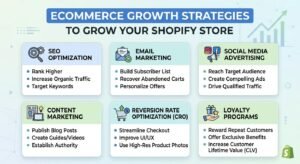
Effective ecommerce growth strategies separate Shopify stores that scale from stores that stall after their first few sales. Launching a store is the easy part. Getting it to a point where revenue is consistent and predictable? That’s where most merchants get stuck. It’s tempting to think that adding more products, or running one big sale, will unlock growth on its own. It usually doesn’t. Real results come down to solid ecommerce marketing, not just a bigger catalog.
So what actually moves the needle? Three things, mostly: traffic (getting the right people to your site), conversions (getting them to actually buy), and retention (getting them to come back). Nail one of these and ignore the others, and you’ll hit a wall pretty fast. Great traffic with a leaky checkout just burns ad spend. Good conversions without any retention plan means you’re starting from zero every single month.
Below are 13 strategies that, together, cover all three of those levers from knowing who you’re selling to and optimizing for search, right through to recovering lost carts and keeping customers around for the long haul. Some of these you can implement this afternoon. Others take months to pay off. Both matter.
Understand Your Target Customers
Everything else on this list works better, or falls flat, depending on how well you actually know who you’re selling to. It’s also the foundation of efficient customer acquisition. Target the wrong people, and you’ll pay more to convert fewer of them.
Start with the basics: age range, location, income, lifestyle, and most importantly, the problem your product actually solves for them. “Everyone who likes fashion” isn’t a customer profile; it’s a shrug. The more specific you get, the sharper your ad targeting, copy, and product decisions become.
But demographics only tell half the story. What actually triggers someone to buy? Are they comparing five options across three tabs, or adding to cart on impulse at 11 pm? Understanding that emotional layer not just who they are, but how they decide shapes everything from your product page copy to your ad hooks.
None of this has to be guesswork. Shopify already gives you order history, customer segments, and repeat-purchase data. Pair that with Google Analytics and the occasional post-purchase survey, and you’ll have a far clearer picture than most of your competitors bother building.
Optimize Your Shopify Store for SEO
Shopify SEO is one of the few growth channels where the payoff keeps compounding long after you’ve stopped actively working on it, unlike ads, which stop the moment the budget runs out. That’s what makes ecommerce SEO worth the upfront effort, even though it’s slower than most merchants would like.
It starts with keyword research: figuring out what your customers actually type into Google, not what you assume they type. Tools like Ahrefs or Google Keyword Planner help, but so does just reading your own site search data.
From there, your product and collection pages need to be built around those terms, with copy that sounds like a person wrote it, not a spec sheet. Meta titles and descriptions matter too; they’re often the deciding factor in whether someone clicks your result or the one above it.
Two things merchants tend to skip: internal linking (which helps Google understand your site and keeps visitors browsing longer) and image optimization. Compressed images with proper alt text do double duty: faster load times and a shot at ranking in image search.
Create High-Converting Product Pages
Product pages carry a lot of weight. They’re often the only thing standing between a visitor and a sale, which is why product page optimization deserves more than a one-time setup and then never touching it again.
Write descriptions that sell the benefit, not just the specs. Nobody buys a jacket because it’s “100% polyester”; they buy it because it’ll keep them warm on a hike. Photos need to do the job your hands would do in a physical store: multiple angles, lifestyle shots, close-ups on texture or detail.
Then there’s the obvious stuff that still gets overlooked constantly: clear, unambiguous “Add to Cart” buttons, and reviews sitting right there where hesitant buyers can see them. Trust signals aren’t decoration. They’re often the actual reason someone clicks buy.
Use Content Marketing to Attract Organic Traffic
Content marketing builds a traffic engine that doesn’t switch off the second you stop paying for ads, which makes it one of the more durable forms of ecommerce marketing a small store can invest in.
Start with genuinely helpful blog posts, guides, comparisons, and how-tos tied to your niche. Mine your customer service inbox and reviews for real questions people are asking; if they’re asking you, they’re probably Googling it too.
A good content plan mixes informational posts (“how to choose running shoes”) with more commercial ones (“best running shoes for flat feet”), catching shoppers at different points in their decision. Do this consistently, and you start building something search engines and customers both respect: topical authority.
Grow Your Shopify Store Through Social Media
Social media is where a lot of discovery happens now, especially for anything visual. A steady social media marketing presence keeps your brand in front of people between purchases, not just during a launch week.
Instagram works well for product context and brand personality through Stories and Reels. Facebook still earns its place for community and retargeting, particularly with older audiences. TikTok, meanwhile, rewards short, authentic video over polish; sometimes the rougher clips outperform the professionally shot ones.
Two things worth prioritizing regardless of platform: shoppable posts (so people can buy without leaving the app) and user-generated content. A real customer’s photo, even a slightly blurry one, often converts better than your best studio shot.
Build an Effective Email Marketing Strategy
Email marketing stays one of the highest-converting channels in ecommerce for a simple reason: you own the list. No algorithm update can take it away from you overnight.
Grow that list through pop-ups, small incentives, and checkout opt-ins. Once someone subscribes, a solid welcome sequence introduces your brand and often nudges that first purchase along with an offer.
From there, it’s a mix of regular promotional campaigns, product recommendations based on browsing or purchase history, and often overlooked retention emails that check in after a purchase or nudge a replenishment. That last category is where a lot of the long-term value sits.
Use Paid Advertising to Reach More Customers
Paid advertising does one thing exceptionally well: it puts your store in front of people who haven’t found you yet.
Google Ads catches people already searching with intent; they know roughly what they want. Meta Ads work better for discovery and for retargeting people who’ve already browsed but didn’t buy, which usually delivers a stronger return than cold traffic ever will.
Start small. Test a handful of creative angles and audiences before scaling anything, and let ROAS not gut feeling, decide what gets more budget and what gets paused.
Before moving into the second half of the strategies, here’s a quick reference summarizing all 13 at a glance:
| # | Strategy | Primary Growth Lever | Key Focus |
|---|---|---|---|
| 1 | Understand Your Target Customers | Foundation | Customer research and data |
| 2 | Optimize Your Shopify Store for SEO | Traffic | Keywords, on-page SEO, site structure |
| 3 | Create High-Converting Product Pages | Conversion | Copy, images, trust signals |
| 4 | Use Content Marketing to Attract Organic Traffic | Traffic | Blog content, topical authority |
| 5 | Grow Your Shopify Store Through Social Media | Traffic | Instagram, TikTok, Facebook, UGC |
| 6 | Build an Effective Email Marketing Strategy | Retention | List growth, automation, personalization |
| 7 | Use Paid Advertising to Reach More Customers | Traffic | Google Ads, Meta Ads, retargeting |
| 8 | Recover Abandoned Carts | Conversion | Cart-recovery emails, checkout friction |
| 9 | Improve Your Shopify Conversion Rate | Conversion | Site speed, navigation, checkout UX |
| 10 | Use Influencer and Affiliate Marketing | Traffic | Partnerships, commission-based promotion |
| 11 | Increase Average Order Value | Revenue | Bundles, upsells, cross-sells |
| 12 | Focus on Customer Retention | Retention | Loyalty programs, personalized offers |
| 13 | Track Your Ecommerce Growth | Measurement | Analytics, CAC, AOV, CLV |
Recover Abandoned Carts
Cart abandonment eats more revenue than most merchants realize, but a decent abandoned cart recovery process wins a fair chunk of it back.
Most abandonment comes down to a handful of predictable culprits: shipping costs that show up too late, a checkout with too many steps, or plain old browsing without real intent to buy. Automated cart-recovery emails a gentle nudge, maybe a small incentive recover a surprising share of “lost” sales.
Simplifying checkout itself helps too: fewer fields, guest checkout as an option, nothing that makes someone stop and think twice. Incentives can tip a hesitant buyer over the edge, but use them sparingly; train customers to expect a discount every time, and you’ve just taught them to abandon carts on purpose. A little urgency (real urgency, not fake countdown timers) can help, as long as it doesn’t feel manipulative.
Improve Your Shopify Conversion Rate
Even with strong traffic, small friction points scattered across your store quietly bleed sales. Shopify conversion rate optimization, or conversion rate optimization more broadly, is really just the process of finding those friction points and fixing them one by one.
Simplify navigation so people can actually find what they came for. Speed matters more than most merchants budget for; every extra second of load time costs you conversions, and bloated apps are usually the culprit. Streamline checkout, offer more than one payment method, and make your calls to action impossible to miss.
Trust plays a bigger role than people give it credit for. Security badges, a clear return policy, and visible contact information are small signals, but they’re often what stops someone from bouncing at the last second.
Use Influencer and Affiliate Marketing
Getting the right voice to talk about your product can put it in front of an audience that already trusts that person, making this an efficient path to customer acquisition when done well.
Relevance beats reach here more often than not; a micro-influencer with an engaged, niche following frequently outperforms someone with ten times the followers and none of the connection. Affiliate partnerships let you scale that promotion on a commission basis, so you’re only paying for actual results.
Whichever route you take, track it properly. Unique discount codes or tracking links tell you exactly what each partnership delivered, instead of guessing.
Increase Average Order Value
Getting existing customers to spend a little more per order is usually cheaper and easier than chasing new ones. Raising your average order value is one of the fastest ways to grow revenue without touching your traffic numbers at all.
Bundles work well when the items genuinely go together, not just because they’re sitting in the same warehouse. Upselling nudges someone toward the better version of what they’re already considering; cross-selling suggests something complementary. A free-shipping threshold set just above the average cart size often pushes people to add one more item. “Customers also bought” sections do quiet, steady work in the background too.
Focus on Customer Retention
New customers cost more to acquire than existing ones cost to keep, which makes customer retention one of the most profitable levers on this entire list, and a direct driver of customer lifetime value.
Loyalty programs give people a reason to keep choosing you over a competitor. Personalized offers, built on past purchase behavior, feel less like marketing and more like being understood, which honestly, is the point. Good customer support turns a complaint into a reason to stay, rather than a reason to leave a bad review.
Don’t stop at the sale, either. A simple follow-up after delivery, a care tip, a usage guide, a request for feedback keeps the relationship going well past the transaction itself.
Track Your Ecommerce Growth Strategies
None of the strategies above mean much without measurement. Tracking the right numbers tells you what’s actually working, what isn’t, and where to put your attention next, turning Shopify store optimization into a data-driven habit rather than guesswork, and sharpening your broader Shopify sales strategies over time.
Shopify’s built-in analytics cover a lot of ground already: sales trends, top products, traffic sources. Beyond that, a handful of metrics matter more than the rest: conversion rate, customer acquisition cost, average order value, customer lifetime value, organic traffic growth, and the overall revenue trend. Watch these regularly, and patterns start to show up that you’d otherwise miss entirely.
Common Shopify Growth Mistakes to Avoid
A few missteps show up again and again, quietly stalling growth even when the fundamentals look fine:
- Focusing only on traffic. More visitors won’t help if conversion and retention are both weak.
- Ignoring mobile users. Most ecommerce traffic is mobile now a clunky mobile experience costs sales directly.
- Using too many apps. Every extra app is another thing slowing your store down and cluttering the experience.
- Poor product descriptions. Thin, generic copy fails to answer the questions that actually drive a purchase.
- Neglecting SEO. Skipping it means leaving free, compounding traffic on the table indefinitely.
- Not tracking results. Without real metrics, there’s no way to know which strategies are actually working.
FAQ
-
How can I grow my Shopify store?
Balance three areas: driving the right traffic, converting that traffic once it arrives, and retaining customers so they come back. Start by understanding your target customer, then layer in SEO, content, paid ads, and email testing and tracking as you go.
-
What is the best marketing strategy for Shopify?
There isn’t one single “best” strategy. The strongest approach usually blends channels: SEO for long-term organic traffic, paid ads for faster results, email for retention. The right mix depends on your budget, niche, and how your customers actually shop.
-
How can I increase Shopify sales?
Improve conversion rate through better product pages, a simplified checkout, and visible trust signals. Recover abandoned carts. Push average order value up with bundles and upsells. And keep driving qualified traffic through SEO and paid advertising.
-
How long does it take to grow a Shopify store?
It varies a lot by niche, budget, and how consistently you execute. Paid ads can show results in weeks. SEO and content marketing usually take three to six months, sometimes longer, before real traction shows up. Sustainable growth is rarely one lucky tactic; it’s consistent effort over many months.
-
Is SEO effective for Shopify stores?
Yes, though it’s a slow burn. SEO is one of the most cost-effective long-term channels available because the traffic it generates keeps growing without ongoing ad spend, even if it takes longer to show results than a paid campaign would.
Conclusion
A lasting ecommerce growth strategy was never about finding one silver-bullet tactic. It’s about building a system where traffic, conversions, and retention keep reinforcing each other. The 13 tactics above form a complete Shopify store marketing strategy, from understanding your customers and optimizing for search to recovering abandoned carts and keeping people around long after their first order, and they work best applied together, not picked one at a time.
If you only take one thing from this: prioritize SEO for traffic that compounds, conversion optimization to make the most of the visitors you already have, and retention to turn one-time buyers into repeat ones. No two stores grow the same way, so test, measure honestly, and double down on whatever actually moves your numbers. Growth here is rarely instant, but it does compound.

One Response