A business can have an excellent product, a thoughtful service, and a well-designed website, yet remain unseen by people searching for what it offers. In the digital world, being present online is not the same as being discovered. Every search creates an opportunity for websites to reach potential visitors, but only relevant and useful pages can compete effectively for attention.
This is where SERP analysis in SEO becomes important. It helps website owners understand what appears in search results, what users are looking for, and how competing pages address their needs.
SERP analysis is more than checking which websites rank on Google. It involves examining search intent, identifying ranking opportunities, reviewing competitors, and understanding the search features that influence visibility.
By combining SERP analysis with keyword research, content optimization, and performance measurement, businesses can make informed decisions about improving their organic search presence.
In this guide, we will explore five powerful ways to use SERP analysis to improve search visibility, along with a practical step-by-step process for analyzing search results.
What Is SERP Analysis in SEO and Why Does It Matter?
SERP stands for Search Engine Results Page. It is the page displayed after someone enters a query into a search engine such as Google.
SERP analysis is the process of examining these results to understand ranking patterns, search intent, competing content, and opportunities to improve a website’s visibility.
Depending on the search query, a SERP may contain several elements:
- Organic search results: Unpaid website listings selected by search systems.
- Paid search ads: Sponsored placements displayed by advertisers.
- Featured snippets: Short extracts that may directly answer a searcher’s question.
- People Also Ask: Related questions that help users explore a topic.
- Image and video results: Visual content relevant to the search.
- Local results: Business listings and map information for location-based queries.
- Knowledge panels: Information about recognized entities, organizations, and other subjects.
- AI Overviews: AI-generated summaries that may appear for certain searches and provide links to relevant sources.
Understanding these elements helps SEO professionals identify what type of information Google displays for different searches.
For example, a search for “what is technical SEO” may display informational articles, featured snippets, and related questions. However, searching for “SEO agency near me” may display local business listings and service websites.
These differences show why analyzing search results before creating content is important.
SERP visibility can introduce a website to people already looking for a relevant answer, product, or service. However, appearing in search results does not automatically guarantee clicks, engagement, or conversions.
How Search Engines Organize and Display Results
Before analyzing SERPs, it is useful to understand how search engines discover and organize website content.
Google’s search process is commonly explained through three main stages:
1. Crawling
Crawling is the discovery stage. Automated programs, known as crawlers, visit web pages and follow links to discover additional content.
Clear navigation, working internal links, and accessible pages can help crawlers discover important sections of a website.
2. Indexing
Indexing occurs when a search engine analyzes information about a discovered page and may store it in its index.
Content, images, titles, metadata, and other information can help search systems understand a page. However, crawling does not guarantee indexing.
3. Serving Search Results
When someone enters a query, Google’s automated systems evaluate many signals to select and organize relevant results.
These may include query meaning, page relevance, content quality, usability, location, and search context.
Understanding these stages provides a foundation for identifying content and technical issues that may affect search visibility.
5 Powerful Ways to Improve Search Visibility Through SERP Analysis
1. Analyze SERPs to Discover Ranking Opportunities
The first step in SERP analysis is examining the search results for your target keyword. This helps you understand which types of pages are already ranking and what information users expect to find.
Start by searching your primary keyword on Google and reviewing the first page of results.
Pay attention to the following elements:
- Ranking page types: Identify whether Google displays blog posts, product pages, service pages, comparison guides, or videos.
- Title tags and descriptions: Examine recurring topics, benefits, and phrases used by competing pages.
- SERP features: Look for featured snippets, People Also Ask, image results, AI Overviews, and local listings.
- Content formats: Identify whether ranking pages use tutorials, step-by-step guides, product comparisons, or detailed explanations.
- Content depth: Review how thoroughly competing pages explain the topic.
- Freshness: Check whether the search results favor recently updated content.
For example, suppose you search for “best SEO tools for beginners.”
You may find comparison articles, tool reviews, listicles, and videos in the search results. This suggests that users are comparing different options before making a decision.
In this situation, creating a detailed comparison guide may satisfy their needs better than publishing a basic article explaining what SEO tools are.
Competitor analysis can also reveal content gaps. Review the questions, examples, and topics covered by ranking pages. Identify relevant information that is missing, outdated, or not explained clearly.
The objective is not to copy competitors but to create more useful and relevant content.
2. Understand Search Intent Behind Every Query
Search intent is the reason behind a user’s search. A page may contain the correct keyword but still fail to satisfy visitors if it does not match what they actually want.
SERP analysis helps identify the dominant intent behind a query by examining the pages Google displays.
There are four common types of search intent:
Informational Intent
Users want to learn something or find an answer to a question.
Example: “What is technical SEO?”
Guides, tutorials, explainers, and FAQs often satisfy this type of intent.
Navigational Intent
Users want to reach a particular website, brand, or online destination.
Example: “Google Search Console login.”
Clear brand information and accessible navigation help users find the destination they need.
Commercial Investigation
Users are researching and comparing options before making a purchase decision.
Example: “Best SEO tools for beginners.”
Reviews, comparison articles, and buying guides can help satisfy this intent.
Transactional Intent
Users are ready to complete an action, such as purchasing a product, booking a service, or requesting a quote.
Example: “Hire an SEO agency.”
Product pages, service pages, pricing information, and clear calls to action may be appropriate.
How to Identify Search Intent Through SERP Analysis
Follow these steps:
- Search your target keyword on Google.
- Review the top 10 organic results.
- Identify the type of pages ranking for the query.
- Look for common content formats and topics.
- Determine which search intent appears most frequently.
- Create a page that matches the dominant intent.
For example, if most results for a keyword are comparison articles, publishing a simple informational blog post may not be the best approach.
Always analyze the actual search results instead of assuming intent from the keyword alone.
3. Use SEO Data to Identify Improvement Opportunities
SERP analysis helps you understand what appears in search results, while SEO data helps you evaluate how your website performs.
Combining these insights allows you to identify pages that need improvement and discover opportunities to increase organic visibility.
Two important tools for this process are Google Search Console and Google Analytics.
Google Search Console
Google Search Console provides information about how a website performs in Google Search.
Its Performance report includes:
- Impressions: How often your website appears in Google Search results.
- Clicks: How many clicks your website receives from search results.
- Click-Through Rate (CTR): The percentage of impressions that result in clicks.
- Average Position: An approximate average placement of your website in search results for the selected data.
Use this information to identify pages that receive relevant impressions but have a low CTR or queries where your website has visibility but could provide a better answer.
Google Analytics
Google Analytics helps you understand what visitors do after arriving on your website.
Depending on its configuration, it can provide information about acquisition channels, engagement, and important events or conversions.
Keyword Research Tools
Tools such as Google Keyword Planner and third-party SEO platforms can help discover relevant keywords, estimate search demand, and explore competitor visibility.
Remember that metrics from different SEO tools are estimates and may vary.
Practical Example
Suppose a blog post receives 5,000 impressions but only 100 clicks during a selected reporting period.
Its CTR is:
CTR = (100 ÷ 5,000) × 100 = 2%
This may indicate an opportunity to review the page title and meta description, particularly if they do not communicate the value of the content clearly.
However, always compare performance with the query, search position, SERP layout, and search intent before deciding what needs improvement.
4. Optimize Content for Better Search Visibility
Content relevance plays an important role in creating useful pages that satisfy search intent.
A page should provide accurate information, answer the main question, and cover relevant supporting topics.
Here are some ways to improve content relevance:
Create Well-Structured Content
Organize information using descriptive headings, short paragraphs, examples, and lists where appropriate.
Answer the main question early and provide supporting information in a logical order.
Use Semantic Keywords Naturally
Semantic keywords are terms, synonyms, entities, and related concepts connected to the main topic.
For an article about SERP analysis, relevant terms may include:
- Search intent
- Organic search results
- Featured snippets
- Keyword research
- Search visibility
- Click-through rate
- SERP features
- Competitor analysis
- Search result rankings
- Content gaps
Include these terms naturally when they improve the explanation. Avoid inserting related keywords simply to increase their frequency.
Use SERP Features to Find Content Ideas
SERP features can reveal questions and information users are interested in.
For example:
- People Also Ask can help identify related questions to address.
- Featured snippets can show the type of concise answer Google displays for a query.
- Video results can indicate that visual explanations may be useful.
- Image results can highlight the importance of relevant visual content.
- AI Overviews can reveal related concepts and questions worth investigating.
Use these observations as research opportunities rather than treating them as guaranteed ranking targets.
Strengthen On-Page SEO
Optimize important on-page elements to help search engines and visitors understand your content.
Consider the following:
- Write a descriptive and relevant title tag.
- Create a useful meta description.
- Organize content with a logical heading structure.
- Use descriptive internal links to connect related pages.
- Add meaningful alt text to informative images.
- Keep URLs concise and readable.
Avoid Keyword Stuffing
Keyword stuffing is the excessive or unnatural repetition of search phrases within content.
Instead of repeating the same keyword unnecessarily, focus on answering the user’s question and providing useful information.
High-quality content should prioritize clarity, relevance, accuracy, and user experience.
5. Strengthen Technical SEO and User Experience
Even useful content needs a website that people and search engines can access.
Technical SEO focuses on the website foundations that support crawling, indexing, and usability.
During SERP analysis, you may discover opportunities that require technical improvements rather than additional content.
Consider these important areas:
Accessibility and Indexability
Check whether important website pages can be accessed and indexed appropriately.
XML sitemaps help identify important URLs, while robots directives guide crawler access. Also review broken links, unnecessary redirect chains, and accidentally blocked pages.
Mobile Usability
Your website should be readable and easy to navigate on mobile devices.
Check font readability, page layout, navigation, buttons, and content spacing to ensure visitors can interact with your pages comfortably.
Page Experience and Performance
Website performance influences how visitors experience your content.
Review loading performance, interactivity, and visual stability. Google’s Core Web Vitals provide useful measurements for evaluating these aspects.
Technical improvements should make important content easier to access and improve the experience for visitors. However, no single technical metric guarantees higher search rankings.
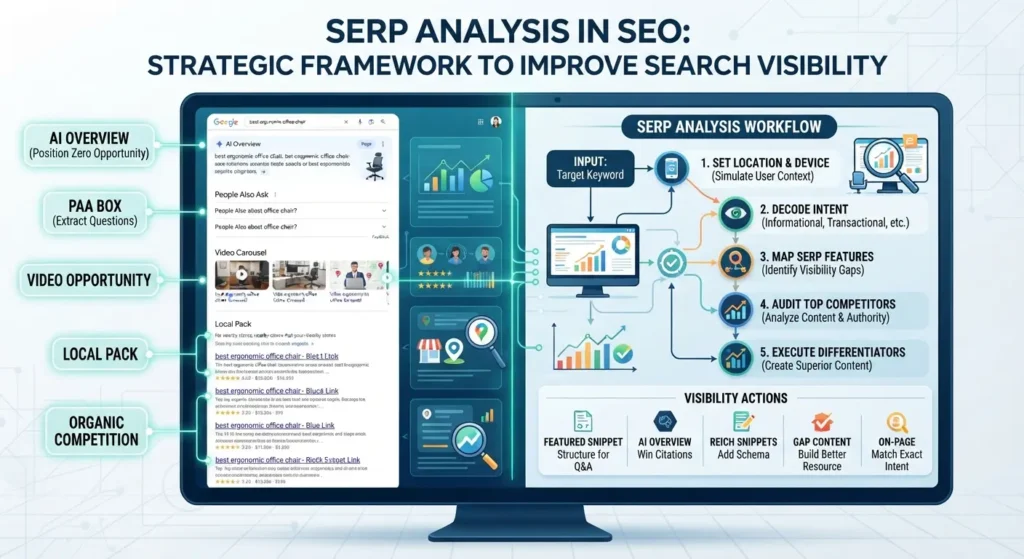
How to Perform SERP Analysis Step by Step
Understanding SERP analysis is useful, but knowing how to perform it makes the process more valuable.
Here is a practical workflow you can follow before creating or optimizing a website page.
Step 1: Select Your Target Keyword
Start with a keyword that is relevant to your website, audience, and business goals.
For example: “Best SEO tools for beginners.”
Step 2: Search Your Keyword on Google
Enter the target keyword into Google and examine the search results.
Use the appropriate target location and language when researching local or country-specific keywords.
Step 3: Analyze the Top 10 Organic Results
Review the first 10 organic listings and note:
- Page titles and URLs.
- Website types and competing domains.
- Content formats.
- Main topics and subheadings.
- Examples, images, and supporting information.
Do not rely only on domain authority or the number of backlinks. Relevance and the quality of the page also matter.
Step 4: Identify Search Intent
Determine whether the results mainly satisfy informational, navigational, commercial investigation, or transactional intent.
Look for patterns across multiple ranking pages rather than judging from a single result.
Step 5: Examine SERP Features
Check whether the results include featured snippets, People Also Ask, video results, image packs, local listings, or AI Overviews.
These features can help you understand how Google presents information for the query.
Step 6: Find Content Gaps
Compare the information provided by competing pages.
Look for:
- Questions that are not answered clearly.
- Missing practical examples.
- Outdated information.
- Important subtopics that receive limited coverage.
- Opportunities to explain complex information more simply.
Step 7: Build Your Content Strategy
Use your findings to create a page that matches search intent and provides meaningful value.
Organize the information into a logical heading structure and include relevant examples, supporting keywords, and internal links.
The goal is to create the most useful content for your intended audience, not simply the longest article.
Important SERP Features Every SEO Should Analyze
SERP features influence how information appears on search engine results pages. Understanding them can help SEO professionals identify opportunities to improve content relevance and search visibility.
Here are some important SERP features:
1. Featured Snippets
Featured snippets display a selected extract from a webpage that directly answers a search query.
They may appear as paragraphs, lists, or tables.
To improve your chances of being useful for snippet-based queries, provide clear, direct answers and structure relevant information logically. However, there is no guaranteed method to earn a featured snippet.
2. People Also Ask
People Also Ask displays related questions connected to the original search query.
It helps users explore a topic further and can provide useful ideas for FAQs and supporting content.
3. Local Pack
The Local Pack displays relevant local business listings, often alongside a map.
It is particularly important for searches with local intent, such as “digital marketing agency in Hafizabad.”
Businesses can improve their local search presence through accurate Google Business Profile information, relevant business details, and strong customer experiences.
4. Image and Video Results
Image and video results provide visual information related to a search query.
These features may indicate that users benefit from demonstrations, tutorials, product images, or other visual explanations.
5. AI Overviews
AI Overviews provide AI-generated summaries for certain search queries.
They may include links to webpages that help users explore information further.
SEO professionals should examine the topics and sources presented in these summaries and ensure their own content provides accurate, relevant, and helpful information.
SERP features vary depending on the query, location, language, device, and search context. Their presence should always be verified through actual search results.
How to Turn SERP Insights into a Practical SEO Strategy
Research becomes valuable when it leads to meaningful improvements.
After completing SERP analysis, organize your findings into a practical SEO strategy.
Start by giving each important page a clear purpose and a primary search topic. Add supporting subtopics that naturally develop the subject, and avoid creating multiple pages targeting the same search intent without a meaningful difference.
A balanced content strategy may include:
- Educational articles for informational searches.
- Product and service pages for transactional searches.
- Comparison articles for commercial investigation.
- Local landing pages for businesses serving specific areas.
Prioritize improvements by considering audience relevance, content quality, required effort, and opportunities identified through available SEO data.
You can also document your findings in a SERP analysis sheet to make competitor comparisons and future updates easier.
How to Measure SERP Performance and Refine Your Approach
SEO is an ongoing process. Search behavior, competition, and search result layouts change over time, so regular performance reviews are important.
Some useful metrics include:
- Organic clicks
- Search impressions
- Click-through rate
- Average search position
- Website engagement
- Conversions
Use Google Search Console to monitor organic search performance and Google Analytics to understand visitor activity after arrival.
For example, if a page receives many impressions but few clicks, review its title tag and meta description.
If visitors arrive but do not engage with the content, examine the page’s search intent alignment, content quality, and user experience.
A practical routine may include reviewing important pages monthly and evaluating broader content and technical SEO priorities quarterly.
The review schedule should depend on the website, available data, and how quickly its market changes.
FAQ
-
What is SERP analysis in SEO?
SERP analysis in SEO is the process of examining search engine results to understand search intent, analyze competing pages, identify SERP features, and discover opportunities to improve organic search visibility.
- Why is SERP analysis important for SEO?SERP analysis helps SEO professionals understand what users expect from a search query, identify competitors’ content strategies, discover content gaps, and create pages that better match search intent.
- How do you perform SERP analysis?Start by selecting a target keyword and searching it on Google. Analyze the top 10 organic results, identify search intent, examine SERP features, compare competitor content, and find opportunities to create more useful and relevant content.
- Which tools are best for SERP analysis?Google Search, Google Search Console, Semrush, Ahrefs, and Google Keyword Planner are useful tools for analyzing search results, researching keywords, monitoring website performance, and identifying competitor opportunities.
- What are the main SERP features in Google?Common Google SERP features include featured snippets, People Also Ask, AI Overviews, local packs, image results, video results, knowledge panels, and paid advertisements. These features provide different ways for users to discover information in search results.
Conclusion
SERP analysis in SEO helps website owners understand how search results work, what users expect, and where opportunities for better organic visibility exist.
By analyzing ranking pages, understanding search intent, examining SERP features, using SEO data, optimizing content, and strengthening technical SEO, businesses can build a more effective search strategy.
However, improving search visibility is not about copying competitors or adding more keywords to a page. It requires understanding the audience, providing relevant information, and continuously evaluating performance.
When research, content quality, technical SEO, and user experience work together, a website can build a stronger foundation for meaningful organic growth.