Having a website is a good start for any business, but what happens when potential customers cannot find it on Google?
This is a common problem for businesses in Pakistan. You might have a well-designed website, offer quality products or services, and still struggle to attract visitors. The missing piece could be search engine optimization (SEO).
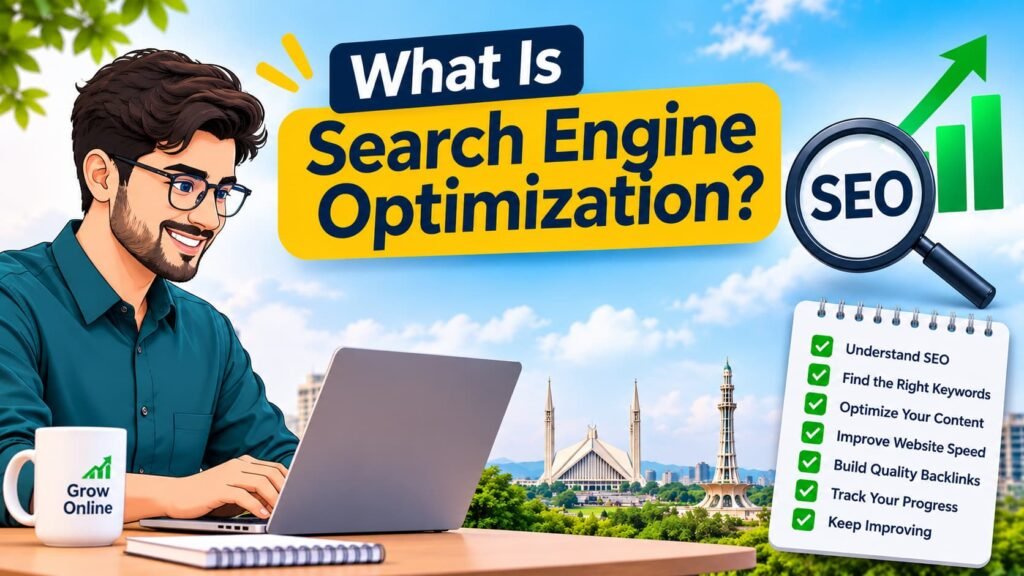
If you have been wondering what is search engine optimization and how it can help your business, this guide will walk you through the basics.
Search engine optimization is the process of improving your website so it can appear more prominently in unpaid search results. It helps people discover your business when they search for information, products, or services related to what you offer.
In this guide, we will explain how SEO works, explore its four main types, understand keyword research, and walk through seven practical steps to improve your website’s SEO in Pakistan.
What Is Search Engine Optimization (SEO)?
Search Engine Optimization (SEO) is the process of improving a website to increase its visibility in organic search results on search engines such as Google.
Search engines use automated systems to discover web pages, understand their content, store information in an index, and rank relevant pages for different search queries.
SEO helps search engines understand your website while making its content more useful and accessible to visitors.
For example, imagine someone searching for “digital marketing agency in Hafizabad.” Google displays pages it considers relevant and helpful for that search. Websites with useful information, relevant content, and a good user experience have an opportunity to earn greater visibility.
In simple words, SEO means improving your website so people can find it when they search on Google for something related to your business.
The main goal of SEO is not simply to attract more visitors. It is to reach the right people with information that answers their questions and meets their needs.
Why Is SEO Important for Businesses?
Think about how you search for a product or service online. You probably open Google, type what you need, and explore the results.
Your potential customers do the same.
SEO helps businesses become visible during these searches. Here are five important benefits.
1. Increase Organic Traffic
SEO helps your website appear for relevant search queries, bringing visitors who are already interested in your products, services, or information.
Unlike paid advertising, organic search listings do not charge you for every click. However, achieving and maintaining visibility requires ongoing effort.
2. Build Brand Trust and Credibility
People are more likely to trust businesses that provide useful information, maintain accurate website details, and offer a positive browsing experience.
Publishing helpful content and maintaining a professional online presence can strengthen your brand’s credibility.
3. Generate Qualified Leads
Not every website visitor becomes a customer. The goal is to attract people who are genuinely interested in what you offer.
For example, someone searching for “SEO services in Pakistan” may be comparing agencies before choosing one. A relevant service page can help that person understand your services and take the next step.
4. Improve Website User Experience
SEO encourages improvements that make websites easier to use.
These include faster loading pages, mobile-friendly layouts, clear navigation, and well-organized content.
When visitors can find what they need without frustration, they have a better experience.
5. Support Long-Term Business Growth
Organic search can become a consistent source of website traffic over time.
However, SEO is not a one-time activity. Search competition changes, websites evolve, and content needs regular improvement. Rankings and traffic are never guaranteed.
What Are the Four Main Types of SEO?
SEO covers several activities, but four main types are commonly discussed: on-page SEO, technical SEO, off-page SEO, and local SEO.
Each focuses on a different part of your website’s visibility.
1. On-Page SEO
On-page SEO involves improving individual website pages so their content is relevant, understandable, and useful to visitors and search engines.
Important on-page SEO activities include:
- Title tags: Write unique and descriptive titles that clearly explain each page’s topic.
- Meta descriptions: Create short summaries that encourage relevant people to visit your page.
- Heading tags: Organize content using one clear H1 heading and descriptive H2 and H3 headings.
- Keyword optimization: Include primary and related keywords naturally where they make sense.
- Internal linking: Connect related pages to help visitors and search engines discover more useful content.
- Image optimization: Compress images, use descriptive file names, and add meaningful alt text when appropriate.
- Content optimization: Publish original, accurate information that answers your audience’s questions.
The purpose is simple: make every important page clear, relevant, and useful.
2. Technical SEO
Technical SEO focuses on helping search engines discover, crawl, render, and index your website pages efficiently.
Even excellent content can struggle to gain visibility if search engines cannot properly access or understand the pages.
Important technical SEO activities include:
- Creating and submitting an XML sitemap.
- Checking robots.txt directives.
- Fixing broken links and redirect issues.
- Improving website speed and Core Web Vitals.
- Ensuring mobile usability.
- Managing duplicate URLs with appropriate canonical tags.
- Monitoring indexing issues in Google Search Console.
- Implementing relevant structured data (schema markup) correctly.
For a deeper understanding of structured data, read our guide to JSON-LD vs Microdata vs RDFa.
Technical improvements make your website more accessible to search engines, but they do not guarantee higher rankings on their own.
3. Off-Page SEO
Off-page SEO includes activities outside your website that help build your brand’s reputation, credibility, and authority.
One of its most important elements is backlinks. These are links from other websites pointing to your website.
You can build your off-page SEO through:
- Earning relevant, high-quality backlinks.
- Publishing useful resources that other websites want to reference.
- Building relationships with industry publishers.
- Using digital PR to earn genuine brand mentions.
- Getting relevant editorial links from trustworthy websites.
Remember, the quality and relevance of backlinks matter more than their total number. Avoid spammy link packages and manipulative link-building schemes.
4. Local SEO
Local SEO helps businesses improve their visibility in location-based searches on Google Search and Google Maps.
For example, when someone searches for “SEO services in Hafizabad,” they may see businesses serving that location.
Local SEO is particularly useful for shops, clinics, educational institutes, restaurants, and service providers that depend on customers from specific areas.
Here are some important local SEO activities:
- Claim and optimize your Google Business Profile.
- Keep your business name, address, phone number, and operating hours accurate.
- Choose relevant business categories.
- Encourage genuine customer reviews.
- Build relevant local citations and directory listings.
- Create useful location-specific service pages.
- Maintain consistent business information across relevant platforms.
A complete and accurate online business presence makes it easier for potential customers to discover and contact you.
What Is Keyword Research in SEO?
Keyword research is the process of finding and analyzing the search terms people use to discover information, products, and services.
It helps you understand what your audience is looking for and what type of content you should create.
For example, a digital marketing agency in Pakistan might research keywords such as:
- SEO services
- Local SEO services
- Website optimization services
- Affordable SEO packages
- SEO agency in Pakistan
These searches represent different needs and may require different website pages.
How to Choose the Right Keywords
You do not need to guess what people are searching for. A structured keyword research process can help.
Follow these steps:
- Identify your audience: Understand who your potential customers are and what they need.
- Find seed keywords: List the basic terms related to your products, services, and business.
- Discover long-tail keywords: Expand your list with specific phrases and questions people search for.
- Check search volume and keyword difficulty: Evaluate estimated demand and competition.
- Understand search intent: Identify what users actually want when they search for a particular phrase.
- Group related keywords: Organize similar terms into relevant keyword groups.
- Map keywords to pages: Assign each keyword group to the most appropriate website page.
Keyword research tools can help you discover opportunities, but search volume should not be your only consideration.
A keyword with fewer searches that attracts a potential customer can be more valuable than a high-volume keyword that brings irrelevant visitors.
For a more detailed walkthrough, read our guide on how to find the right keywords for a small business website.
You can also explore our list of SEO tools for small businesses.
Understanding Search Intent
Have you ever searched for something on Google and received results that did not match what you wanted?
This happens when search results do not satisfy the user’s search intent.
Search intent is the reason behind a search query. Understanding it helps you create content that answers the question or solves the problem a visitor actually has.
There are four common types of search intent.
1. Informational Intent
The user wants to learn something or find an answer.
Example: “What is SEO?”
Best content: Educational articles, guides, tutorials, and explainers.
2. Navigational Intent
The user wants to find a specific website or page.
Example: “Google Search Console login.”
Best content: Clear website navigation and accessible brand pages.
3. Commercial Intent
The user is researching and comparing options before making a decision.
Example: “Best SEO tools for small businesses.”
Best content: Product comparisons, evaluations, reviews, and detailed service guides.
4. Transactional Intent
The user is ready to take action, such as purchasing a product or hiring a service provider.
Example: “Hire an SEO expert.”
Best content: Service pages, pricing information, and clear enquiry forms.
When you understand search intent, you can create pages that match what people expect to find instead of simply adding keywords to your content.
SEO in the Age of Artificial Intelligence
Search technology is changing. People can now discover information through traditional search results, AI-generated summaries, and conversational AI tools.
These developments are changing how users find information, but they do not make traditional SEO irrelevant.
Websites still need useful content, clear information, accessible pages, and a positive user experience.
To prepare your website for evolving search experiences:
- Publish accurate, original, and helpful content.
- Answer relevant questions clearly.
- Demonstrate real experience and expertise.
- Organize information with descriptive headings.
- Support important factual claims with reliable sources.
- Maintain a technically accessible website.
- Build a recognizable brand with accurate business information.
What Are AI SEO, AEO, and GEO?
You may come across three terms when researching the relationship between SEO and artificial intelligence.
AI SEO: A broad term for applying SEO principles to search experiences that use artificial intelligence.
Answer Engine Optimization (AEO): Focuses on making information clear and useful for systems that provide direct answers to user questions.
Generative Engine Optimization (GEO): Focuses on improving the likelihood that useful information about a brand or topic appears in generative AI responses.
These approaches overlap with traditional SEO. However, there is no guaranteed technique that ensures your website will appear in every AI-generated answer.
If you want to explore this topic further, read our articles about entity clarity and keyword stuffing, AI crawlers on your website, and E-E-A-T in SEO.
How to Improve Your Website’s SEO in 7 Steps
Understanding SEO is important, but knowing where to start can be confusing.
Whether you manage a small business website or a personal blog, these seven steps will help you build a practical SEO foundation.
Step 1: Conduct an SEO Audit
Before making changes, understand how your website is performing.
An SEO audit helps identify issues that may affect your website’s visibility and user experience.
Start by checking:
- Technical errors and indexing issues.
- Missing or duplicate title tags and meta descriptions.
- Broken links and redirect problems.
- Duplicate or thin content.
- Website speed and mobile usability.
- Missing content and keyword opportunities.
You can start with free tools such as Google Search Console and Google PageSpeed Insights.
An audit gives you a clearer picture of what needs attention first.
Step 2: Research Relevant Keywords
Once you understand your website’s condition, identify the search terms your potential customers use.
Choose keywords that match your audience, business goals, and the purpose of each page.
For example, a local service provider in Hafizabad might target location-specific searches instead of competing only for broad national keywords.
Check search intent, estimated search volume, and competition before selecting your primary and secondary keywords.
The goal is to choose relevant keywords that connect your content with the right audience.
Step 3: Optimize On-Page Elements
After selecting your keywords, use them naturally throughout the relevant website pages.
Focus on these elements:
- SEO titles and meta descriptions.
- Main headings and subheadings.
- Page URLs.
- Relevant internal links.
- Image file names and alt text.
- Helpful and well-organized page content.
Every important page should have one clear purpose.
Avoid repeating the same keyword unnecessarily. Your content should sound natural when someone reads it.
Step 4: Create Helpful Content
Content gives people a reason to visit your website.
Create articles, guides, service pages, and resources that answer genuine questions and help visitors make informed decisions.
For example, a digital marketing agency can publish educational articles about SEO, website optimization, local search, and digital marketing strategies.
When creating content:
- Understand what your audience wants to know.
- Provide accurate and useful information.
- Use practical examples where possible.
- Support important claims with reliable sources.
- Update outdated information when necessary.
Do not publish content simply to increase your website’s page count. Every page should offer something valuable to readers.
Step 5: Improve Website Performance
A website should be easy to access and use, especially on mobile devices.
Start by testing your website on different screen sizes. Check whether pages load properly, buttons work correctly, and visitors can find important information without difficulty.
You should also monitor the three Core Web Vitals:
- Largest Contentful Paint (LCP): Measures loading performance. A good result is 2.5 seconds or less.
- Interaction to Next Paint (INP): Measures responsiveness. A good result is 200 milliseconds or less.
- Cumulative Layout Shift (CLS): Measures visual stability. A good result is 0.1 or less.
Google evaluates these metrics at the 75th percentile of page visits.
You can use PageSpeed Insights to identify performance problems and opportunities for improvement.
For practical solutions, read our guide on how to improve Core Web Vitals: 7 proven fixes.
Step 6: Earn Quality Backlinks
Backlinks can help search engines understand your website’s reputation and relevance.
However, building backlinks is not about collecting as many links as possible.
Focus on earning relevant links through:
- Publishing original and useful resources.
- Building relationships with relevant websites and publishers.
- Contributing valuable industry insights.
- Participating in legitimate digital PR opportunities.
- Creating content that others naturally want to reference.
Avoid automated link schemes and manipulative practices. A smaller number of relevant, editorially justified links is generally more valuable than a large collection of low-quality links.
Step 7: Track Your SEO Performance
SEO does not end after publishing content or optimizing your website.
You need to monitor performance to understand whether your efforts are producing useful results.
Google Search Console helps you track:
- Total impressions.
- Organic clicks.
- Click-through rate (CTR).
- Search queries.
- Average search position.
- Website indexing information.
You can also use an analytics platform to monitor organic traffic, user engagement, enquiries, and conversions.
Review your data regularly. If a page receives impressions but few clicks, you may need to improve its title or description. If visitors leave without taking action, review the content and user experience.
Use these insights to identify what is working and where your next SEO improvement should focus.
Common SEO Mistakes to Avoid
Even when you follow SEO best practices, certain mistakes can weaken your website’s performance.
Here are some common problems to watch for:
Keyword stuffing: Repeating keywords unnaturally throughout your content.
Thin content: Publishing pages that provide little useful information.
Spammy backlinks: Using manipulative link-building methods.
Poor internal linking: Making important pages difficult for visitors and search engines to discover.
Ignoring technical SEO: Overlooking crawling, indexing, and website performance issues.
Mismatched search intent: Creating content that does not answer what people are actually searching for.
Poor mobile usability: Making your website difficult to navigate on smartphones.
Duplicate content: Creating unnecessary pages that serve the same purpose.
Expecting instant results: Treating SEO as a one-time activity instead of an ongoing process.
The best approach is to focus on content quality, technical accessibility, relevance, and user satisfaction rather than trying to manipulate search rankings.
Conclusion
Search engine optimization helps businesses improve their organic search visibility, attract relevant visitors, and create opportunities for long-term growth.
By combining on-page SEO, technical SEO, off-page SEO, local SEO, keyword research, and helpful content, you can build a stronger foundation for your website’s search performance.
For Pakistani businesses, understanding local search behavior and creating content that matches the needs of their audience can make a meaningful difference.
Start with the basics, monitor your progress, and improve your website consistently. SEO takes time, but a well-planned strategy can help your business become easier to discover online.
The most important thing is to create value for people first and make that value easy for search engines to discover and understand.
If you need professional support, contact the DevEx team to learn more about our SEO services in Hafizabad and across Pakistan.
FAQ
-
What is search engine optimization in simple words?
Search engine optimization is the process of improving your website so people can find it on Google when they search for products, services, or information related to your business.
It involves improving website content, technical performance, online reputation, and local visibility.
-
How does search engine optimization work?
Search engines discover web pages through crawling, organize information through indexing, and rank eligible pages based on relevance and many other signals.
SEO helps make your website easier to discover and understand while providing useful information that satisfies search intent.
-
How long does SEO take to show results?
SEO results depend on competition, website condition, content quality, and available resources.
Meaningful improvements often take several months, and some changes may take longer. Be careful with anyone promising instant or guaranteed rankings.
-
Is SEO free?
Organic search listings do not charge businesses for each click. However, SEO may involve costs for professional services, tools, content creation, and technical improvements.
-
Is SEO still important in 2026?
Yes. Search engines remain an important way for people to discover websites, products, and services. Good SEO practices also support discoverability across evolving AI-powered search experiences.
-
Can I do SEO without coding?
Yes. Beginners can perform many SEO activities using platforms and tools such as WordPress, Rank Math, and Google Search Console.
However, more complex technical SEO problems may require coding knowledge or help from a developer.
-
What is the difference between SEO and paid advertising?
SEO focuses on improving organic visibility in unpaid search results, while paid advertising allows businesses to pay for ad placements.
Paid ads can generate traffic quickly while campaigns are running. SEO generally takes longer to build but can continue attracting organic visitors without a fee for each click.